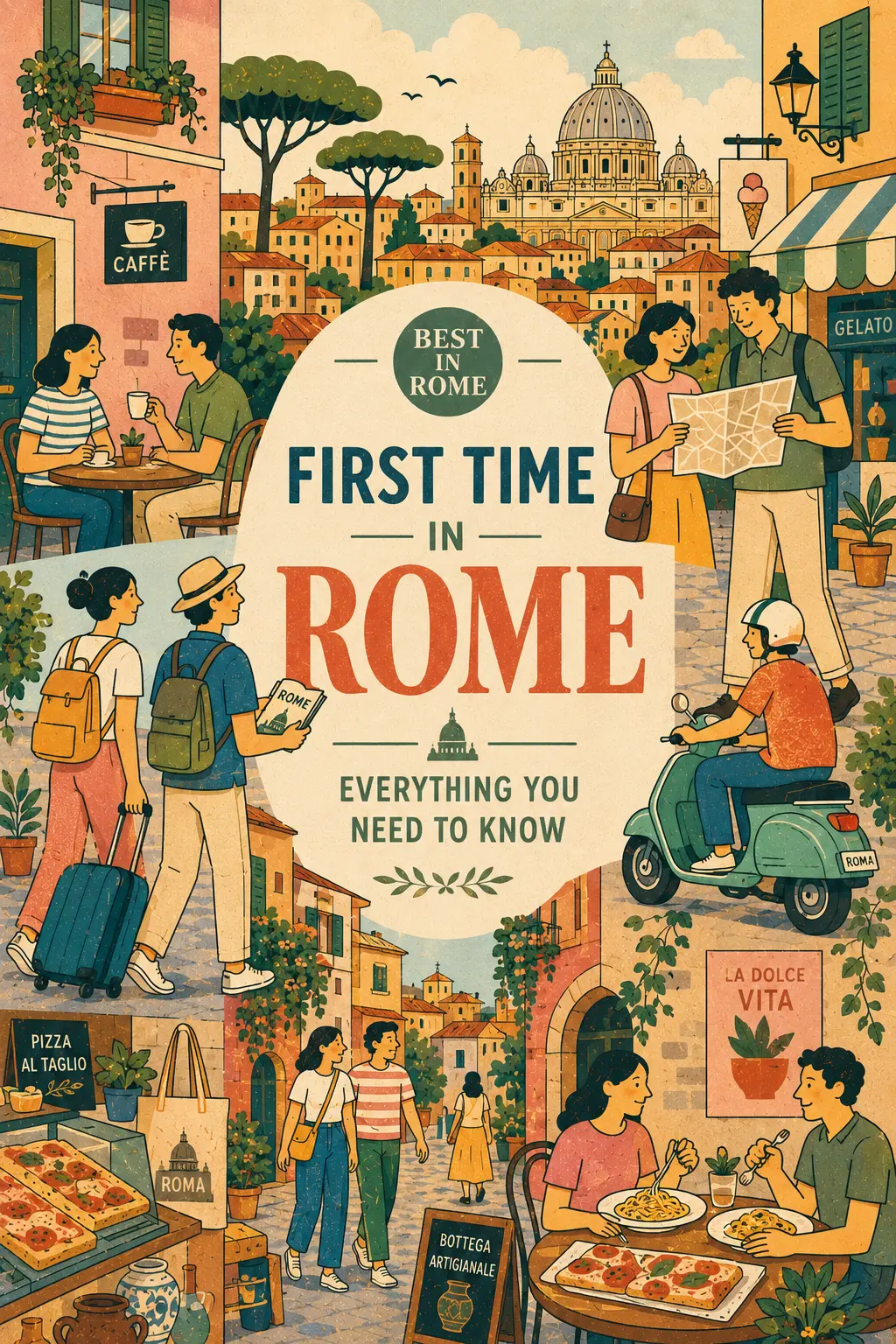

Rome is not a city you can understand in a weekend. It has been building itself for nearly three thousand years and shows no signs of stopping. There are layers here that most visitors never reach, and the distance between the tourist version of Rome and the real one is wider than you might expect.
I was born and raised in this city. This guide is what I would tell a friend visiting for the first time: the practical things you need to know, the mistakes to avoid, and the details that will make the difference between a good trip and one you will remember.
The Two Biggest Mistakes First-Time Visitors Make
1. Trying to see everything. Rome is enormous. The historic centre alone takes days to walk properly, and the city extends far beyond it. Tourists who try to fit the Colosseum, the Vatican, the Trevi Fountain, the Pantheon, Trastevere and the Spanish Steps into a single day end up exhausted, overheated and frustrated. Rome rewards slowness. Pick two or three things per day and give yourself time between them.
2. Following social media instead of real guides. The restaurants, gelato shops and “hidden” spots promoted on Instagram and TikTok are almost always optimised for content, not for quality. The places with the best lighting and the most photogenic dishes are rarely the places where Romans eat. If a restaurant has a queue of people holding phones and nobody over 40, it is probably not the one you want. Follow local guides written by people who actually live here.
Where to Stay in Rome
The neighbourhood you choose changes the trip. Three areas I would recommend to a first-time visitor:
San Giovanni. This is where you find authentic Roman atmosphere at honest prices. The area around the Basilica di San Giovanni in Laterano is residential, well connected by Metro A and C, and full of the kind of neighbourhood life that the tourist centre has largely lost. Trattorie, alimentari, local bars. It is not glamorous, but it is real.
Monti. The most interesting neighbourhood in the centre. Narrow streets, independent shops, good restaurants, and a 10-minute walk to the Colosseum. Monti has a village-like character that makes it feel distinct from the rest of the historic centre. It is more expensive than San Giovanni but the location is hard to beat.
Trastevere. The historic rione on the west bank of the Tiber. Cobblestone streets, ivy-covered buildings, and one of the best bar and restaurant scenes in the city. It gets noisy at night in summer, particularly around Piazza Trilussa, so choose your street carefully. But for atmosphere and character, few neighbourhoods in Rome come close.
A note on Termini. The area around the main train station is convenient for transport but can feel rough at night, as in many large European cities. If you stay near Termini, book on the side toward Monti or the Esquilino rather than the side toward Via Marsala.
If you are staying outside the centre, check the transport connections before you book. Rome’s metro has only three lines and the bus network, while extensive, can be slow and unpredictable. Being 30 minutes from the centre by metro is fine. Being 30 minutes by bus that comes every 40 minutes is not.
Scams and Tourist Traps to Avoid
Rome is a safe city, but it has a well-developed ecosystem of minor scams and overpriced services aimed at tourists. Knowing about them in advance makes them easy to avoid.
Restaurants with photos on the menu and a person stationed outside inviting you in are almost always tourist traps. A good Roman restaurant has a short handwritten menu, no photos, and no one standing at the door.
The “gladiators” at the Colosseum will pose for a photo with you and then demand money, sometimes aggressively. The same applies to anyone who tries to put a bracelet on your wrist or give you a rose. If someone offers you something for free near a tourist monument, it is not free.
Taxis without a meter running or that take indirect routes are a known problem. Always check that the meter is on when you get in, or agree on a fixed fare before departure. Our transport guide covers taxi fares and all other transport options in detail.
Overpriced gelato and coffee near monuments. A gelato that costs €6 near the Trevi Fountain costs €2.50 two streets away. A coffee that costs €3 at a tourist bar costs €1.20 at any normal bar in Rome. Walk a block in any direction from a major monument and the prices drop immediately.
How to Get Around Rome
The short version: walk as much as you can, use the metro for longer distances, take buses when the metro does not reach, and use taxis or rideshare apps at night.
The metro has three lines. Line A runs from Battistia to Anagnina, covering the Vatican area (Ottaviano), Piazza di Spagna, Piazza Barberini and San Giovanni. Line B runs from Laurentina to Rebibbia/Jonio, covering Termini, the Colosseum (Colosseo stop), Piramide/Testaccio and EUR. Line C is newer and still expanding. A single BIT ticket costs €1.50 and is valid for 100 minutes on all public transport.
For the complete picture including taxi fares, airport transfers, the Metromare to Ostia, and how to avoid getting scammed on transport, read our full guide to getting around Rome.
What to Eat (and Where)
Roman cuisine is one of the oldest continuously evolving food traditions in the world. The ingredients are simple, the techniques are direct, and the results are extraordinary when done properly. Here is where to start.
The essential dishes. Carbonara, amatriciana, cacio e pepe, gricia, supplì, carciofi alla giudia, and maritozzo con la panna for breakfast. Our guide to traditional Roman food covers all ten dishes you need to try, with verified restaurants for each one.
Pizza. Roman pizza is not Neapolitan pizza. It is thin, crisp and crackling, rolled with a wooden pin and baked until it snaps. We have a dedicated guide to the 10 best places for real Roman scrocchiarella.
Gelato. Most of what you see near the monuments is industrial product with food colouring. Real artisanal gelato looks different: muted colours, pozzetti with lids, no fluffy mountains on display. Our gelato guide covers 9 places a Roman actually goes to.
Craft beer. Rome has a serious craft beer scene that most visitors never discover. If you drink good beer, read our craft beer guide for the best breweries and tap rooms.
Food shopping. If you want to bring something home, Rome has extraordinary delicatessens and food markets. Our shopping guide covers Roscioli, Volpetti and the markets.
One rule to remember: if a restaurant is genuinely Roman, nobody at the table will be drinking a spritz with the pasta. A spritz is an aperitivo, served before food. When the carbonara arrives, it is wine or water. Nothing else.
What to See
The Classics
You are in Rome for the first time, so yes, you should see the Colosseum, the Vatican, the Pantheon, the Trevi Fountain and the Roman Forum. They are famous for a reason and they are genuinely extraordinary.
The practical advice that matters: book the Colosseum online in advance at ticketing.colosseo.it. Tickets cost €18 for the standard entry (Colosseum, Forum and Palatine Hill) or €22 for the Full Experience including the arena and underground levels. Tickets sell out days ahead in summer. Do not show up without a booking.
The Vatican Museums (€20 plus €5 online booking fee at museivaticani.va) are best visited early in the morning or late in the afternoon. The Sistine Chapel is at the end of a long route through the museums, so plan at least three hours. Last Sunday of the month is free entry but expect very long queues.
The Pantheon is free and open daily. Go in the morning when the light comes through the oculus, or during a rainstorm when the rain falls through the hole in the roof and hits the floor. Both are unforgettable.
Beyond the Classics
The real Rome lives outside the tourist circuit. For the best panoramic viewpoints, read our guide to the 7 spots locals actually love. For places most visitors never find, our hidden gems guide covers Coppedè, Villa Torlonia, Parco degli Acquedotti and more.
If you are visiting in spring, the Roseto Comunale above the Circus Maximus is one of the most beautiful free things in the city.
How Many Days Do You Need
Three days is enough for the major monuments and a taste of the food. Five days lets you explore the neighbourhoods, eat at places that are not in the centre, and start to feel the rhythm of the city. A full week lets you live in Rome rather than visit it, which is a different experience entirely. If you have the time, take it. Rome gives back more the slower you go.
When to Visit Rome
Spring (April and May) is the best time. The temperature is comfortable, the roses are in bloom, the city is alive but not yet overwhelmed by summer crowds. If you can choose your month, choose May.
Summer (June to August) is hot, loud and crowded, but the evenings are extraordinary. Our guide to Rome in summer covers how to handle the heat, where to find water and shade, and the beaches near the city.
Autumn (September and October) is the other golden window. Fewer tourists, milder temperatures, and the food is at its seasonal best: artichokes, porcini, new wine.
Winter (November to February) is cold and sometimes wet, but the city is beautifully empty. Museum queues are short, restaurants have tables, and the light on the Forum in December is unlike anything else. For rainy days, our guide to Rome in the rain has you covered.
Rome at Night
Rome after dark is a different city. The monuments are lit, the piazze fill up, and the energy shifts from sightseeing to living. The nightlife is organised by neighbourhood rather than by venue: Trastevere for the classic Roman evening, Pigneto for the alternative scene, Monti for a quieter aperitivo, Testaccio for live music.
Our full guide to Rome nightlife covers every neighbourhood with specific addresses and local recommendations.
Prices: What to Expect
Rome is not cheap, but it is not as expensive as Paris or London if you know where to go. A quick reference:
A coffee (espresso) at the bar: €1.00 to €1.30. A cappuccino: €1.50 to €2.00. If you sit at a table in a tourist area, the price doubles or triples.
A gelato (small, two flavours): €2.50 to €4.00 at honest gelaterie. €5 to €7 at tourist traps near monuments.
A lunch at a trattoria: €12 to €18 for a primo and water. A full dinner with wine: €25 to €45 per person at a good neighbourhood restaurant.
A pizza tonda with a drink: €12 to €18.
A single public transport ticket (BIT): €1.50, valid 100 minutes. A 24-hour pass: €7.00.
Colosseum standard ticket: €18. Vatican Museums: €20 plus €5 online booking fee. Pantheon: free.
Tipping and Paying
In Rome, tipping is appreciated but not expected. The coperto (a cover charge of €1 to €3 per person) is already included on the bill at most restaurants. If the service was good, rounding up or leaving a euro or two is a kind gesture but nobody will be offended if you do not.
Card payments are accepted almost everywhere, including most bars and small shops. Having some cash is useful for markets, street food vendors, and the rare small bar that prefers it.
The Map
All the places mentioned across our guides are marked on our interactive map of Rome, organised by category: restaurants, gelato, craft beer, viewpoints, hidden gems and more. Use it to find what is closest to where you are.
FAQ
Is 3 days enough for Rome? Three days is enough to see the Colosseum, the Vatican, the Pantheon, eat well and walk the main neighbourhoods. It is not enough to understand the city, but it is enough for a very good first visit. If you can stay five days, the experience changes significantly.
Is Rome safe for tourists? Yes. Rome is a safe city by European standards. The main concerns are pickpockets on crowded metro lines and buses (especially line 64 to the Vatican), and the minor scams described above. Use common sense, keep your belongings close in crowds, and avoid the immediate area around Termini station late at night. Beyond that, Rome is a city where people walk freely at any hour.
Do I need to speak Italian in Rome? No. English is widely spoken in restaurants, hotels and tourist sites. However, learning a few basic phrases (buongiorno, grazie, il conto per favore) is appreciated and changes how people respond to you. Romans are warm but they notice effort.
None of the recommendations in this guide are sponsored or paid. These are personal suggestions from a Roman who was born and raised in this city. For more, explore our other guides linked throughout or browse the full local map of Rome.
All practical information verified in June 2026. Prices and opening hours can change, always check directly before visiting.
Leave a Reply