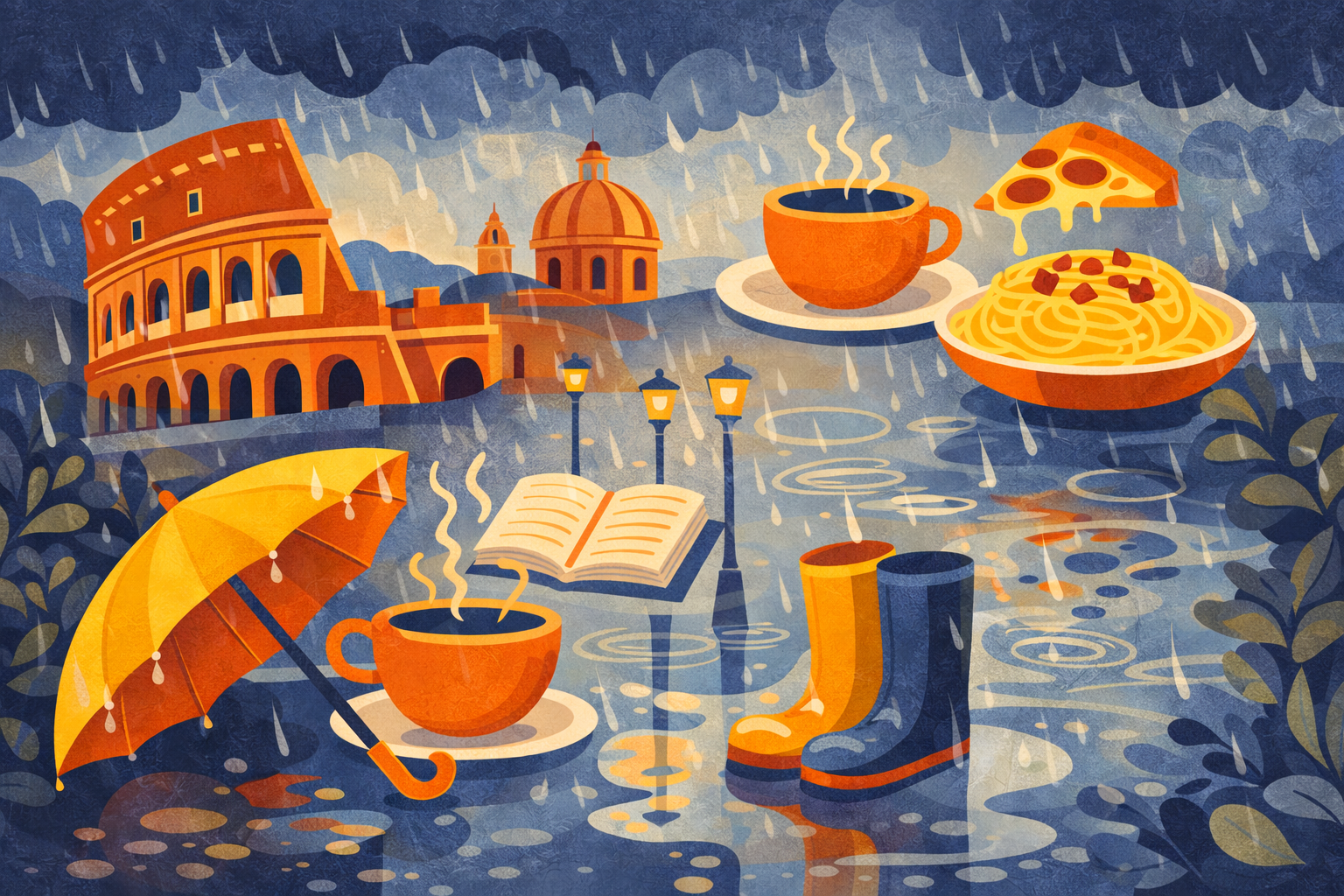

Rome has a reputation for sunshine, and it deserves it. But even the Eternal City gets rainy days, particularly in autumn and spring, and occasionally in the middle of summer when a thunderstorm rolls in from the Castelli Romani hills. If you have planned your trip around outdoor monuments and the weather changes, the temptation is to feel like the day is lost.
It is not. Rome in the rain has qualities the sunny version does not. The tourist crowds thin out noticeably. The cobblestones turn dark and reflective. The city’s indoor spaces, many of them among the best in the world, become significantly more enjoyable when half the usual visitors have retreated to their hotels.
This is what I do on rainy days in Rome, and what I would tell any visitor to do.
1. Go Underground: San Clemente and the Catacombs
Beneath Rome’s street level there is another city, older and quieter, that is entirely unaffected by the weather above.
The best single rainy-day underground visit in Rome is the Basilica di San Clemente, near the Colosseum. The building you enter is a 12th-century church with beautiful medieval mosaics. Below it, reached by a staircase, is a 4th-century church with early Christian frescoes. Below that, accessible through another descent, is a 1st-century Roman house and a functioning pagan temple to Mithras, where you can still hear the sound of an underground stream. Three layers of history stacked directly on top of each other, all accessible in a single visit.
The catacombs along the Appia Antica are the other option. San Callisto and San Sebastiano are the most visited, but Domitilla is larger and often less crowded. All require a guided tour and all are cool, dry and fascinating regardless of what the sky is doing above.
Getting there: San Clemente is at Via di San Giovanni in Laterano 108, a short walk from the Colosseo metro stop. The catacombs are along Via Appia Antica, reachable by bus 118 from the centre.
Practical info: San Clemente entrance €10. The catacombs vary by site, typically €8-10 with a guided tour included. Always check opening hours before visiting as they vary.
2. Galleria Borghese: the Best Small Museum in Rome
The Galleria Borghese is one of those places that justifies the trip to Rome by itself. Housed in a 17th-century villa inside Villa Borghese park, it holds Caravaggio, Bernini, Canova, Raphael and Titian across twenty rooms that feel intimate rather than institutional. The Bernini sculptures alone, including Apollo and Daphne and the Rape of Proserpina, are among the most extraordinary things made by a human being.
Entry is strictly limited to timed sessions of two hours, which means it never feels overcrowded and you can actually look at things properly. This is rare in Rome.
Getting there: Bus 52, 53, 910 to Via Pinciana, then a short walk through the park. Or Metro A to Spagna, then uphill through the park (about 20 minutes on foot).
Practical info: €15 entrance plus €2 booking fee. Booking in advance is not optional, it is mandatory. Book at galleriaborghese.it. The museum is closed Mondays.
3. Sit in a Roman Café and Wait It Out
The Roman café is a specific institution that deserves more credit than it gets. You do not need to order much. A coffee, a cornetto, perhaps a second coffee. The expectation is not that you will leave immediately. Romans have been perfecting the art of sitting in a café during rain for centuries.
Sant’Eustachio il Caffè near the Pantheon is the classic choice: the coffee is exceptional and the location on a small piazza is perfect for watching the rain on the cobblestones. Bar San Calisto in Trastevere is the local alternative, completely unpretentious, famous among Romans for its hot chocolate in winter. Caffè Greco on Via Condotti has been open since 1760 and has the atmosphere to prove it.
On a genuinely heavy rain day, the covered arcade of the Galleria Alberto Sordi on Via del Corso is worth knowing about. It is elegant, free to enter, has shops and cafés, and the ceiling mosaics are worth looking up at.
4. Capitoline Museums: Two Buildings, One Piazza, 2,500 Years of History
The Musei Capitolini on Piazza del Campidoglio, designed by Michelangelo, are among the oldest public museums in the world and one of the best ways to spend four hours in Rome regardless of the weather. The collection spans ancient sculpture, medieval art, Renaissance paintings and an extraordinary collection of Roman imperial portraits.
The highlights: the original Marcus Aurelius equestrian statue (the one in the piazza is a copy), the Capitoline Wolf, the colossal fragments of Constantine, and the view from the café terrace over the Roman Forum below. That last one is worth the museum ticket alone on a clear day. On a rainy day, the Forum looks extraordinary through the terrace windows.
Getting there: Bus 40, 64, H to Piazza Venezia, then a short walk up the Capitoline Hill.
Practical info: €15 full price, €13 reduced. Open Tuesday to Sunday 9:30-19:30, closed Mondays. Free for Rome residents on the first Sunday of the month. Book at museicapitolini.org.
5. Rome’s Churches: the World’s Best Free Indoor Spaces
I have lived in Rome my entire life and I still walk into churches when it rains. Not for religious reasons, though the option is always there. For the architecture, the art, the silence, and the temperature, which is always about ten degrees cooler than the street outside.
Three that are genuinely extraordinary and rarely overcrowded:
San Luigi dei Francesi, near Piazza Navona, has three Caravaggio paintings in the Contarelli Chapel. Free, open daily, one of the most dramatic things in the city.
Santa Maria del Popolo, at the north end of Via del Corso, has two more Caravaggios plus a chapel designed by Raphael and decorated by Bernini. Often nearly empty.
Sant’Ignazio di Loyola, a few minutes from the Pantheon, has a painted ceiling by Andrea Pozzo that creates an illusory dome so convincing that it fooled everyone for years. Stand on the disc in the centre of the nave and look up.
None of these require tickets. All require modest dress (shoulders and knees covered), which in the rain is not difficult to manage.
6. Mercato Trionfale: the Biggest Covered Market in Rome
Most tourists in the Prati area walk straight to the Vatican and miss what is essentially the largest covered market in Rome, two minutes from their hotel. The Mercato Trionfale on Via Andrea Doria has been feeding the Prati neighbourhood since the late 19th century and currently runs to 273 stalls across a large covered structure. Meat, fish, cheese, pasta, fruit and vegetables, olive oil, wine, prepared food.
On a rainy morning it is a genuinely warm and lively place to spend an hour. The food stalls make for a good breakfast or lunch: porchetta panini, pizza al taglio, fresh pasta. The atmosphere is entirely local, with vendors who have been there for decades and a clientele that treats it as part of the weekly routine rather than a tourist attraction.
Worth knowing: Friday is the longest opening day, with stalls running until 11pm.
Getting there: Metro A to Lepanto, then about 12 minutes on foot. Address: Via Andrea Doria, Prati.
Practical info: open Monday, Wednesday, Thursday and Saturday 7:00-14:00; Tuesday 7:00-19:00; Friday 7:00-23:00. Closed Sunday. Free to enter.
7. Casa del Cinema: Film, Archive and a Garden in Villa Borghese
The Casa del Cinema sits inside Villa Borghese in a beautiful early 20th-century building a few minutes’ walk from Via Veneto. It is Rome’s dedicated cinema cultural space: three screening rooms, a film archive with around 5,000 titles available for consultation, two exhibition spaces, a specialist bookshop covering cinema and performance, an aula studio open daily from 10:00 to 20:00, and a café.
The programming is serious: retrospectives, themed cycles, international films in original language with subtitles. Tickets are €5 for most screenings, with some events free. From June through September the outdoor Teatro Ettore Scola hosts free daily screenings, with the indoor Sala Cinecittà as backup when it rains. The Festa del Cinema di Roma takes place here every October.
Getting there: Metro A to Spagna or Flaminio, then a walk through Villa Borghese (about 15 minutes from either). Bus 490, 495, C3. Address: Largo Marcello Mastroianni 1, Villa Borghese.
Practical info: ticket office and infopoint open daily 10:00-22:00. Check the programme at casadelcinema.it.
8. Eat Like a Roman: Comfort Food for a Rainy Day
Cold and rainy in Rome means one thing: find a trattoria and order the things that do not exist outside of this city.
Cacio e pepe is the obvious choice, a dish that looks simple and is not. Coda alla vaccinara, oxtail braised in tomato with celery and bitter chocolate, is what Romans eat when they want to feel warm from the inside. Carciofi alla giudia, deep-fried artichokes in the Jewish style, are available all winter and into spring.
Three places worth knowing for a rainy lunch or dinner: Da Enzo al 29 in Trastevere (small, no reservations, arrive early), Flavio al Velavevodetto in Testaccio (larger, reliable, with a view onto the Monte dei Cocci), and Armando al Pantheon (central, historic, books up fast so reserve in advance).
9. Auditorium Parco della Musica: Renzo Piano, a Roman Villa and a Bookshop
The Auditorium Parco della Musica Ennio Morricone, designed by Renzo Piano and opened in 2002, is one of the most significant buildings constructed in Rome in the last fifty years. Most people go there for concerts. The complex is entirely open to visit during the day without a ticket, and on a rainy afternoon it is one of the better places in the city to spend a few hours.
The three concert halls, shaped like giant beetles and arranged around a central outdoor cavea, can be seen from the walkable terraces. Between two of the halls are the remains of a 4th-century Roman villa discovered during construction, significant enough to substantially change Piano’s original design. The finds are displayed in the small Museo Aristaios beneath the cavea, free to visit.
Beyond the architecture: a large bookshop, a bar-restaurant accessible from the street, and a café inside. The whole complex is walkable, largely covered, and free to explore. The concert programme covers classical music, jazz, contemporary, theatre and family events throughout the year.
Getting there: Bus 490, 495, 61, C3 from the centre. Address: Via Pietro de Coubertin 30, Flaminio.
Practical info: open daily April-October 11:00-20:00, Sunday from 10:00. Entrance to common areas and museum is free. Check the concert programme at auditorium.com.
10. Rome After the Rain
When the rain stops, stay out. Rome after a storm is one of the more photogenic versions of the city. The cobblestones reflect the streetlights. The fountains have a different sound. The air smells of stone and wet pine.
Walk along Via dei Fori Imperiali from Piazza Venezia toward the Colosseum. Or cross Ponte Sant’Angelo and look back at the city from the Tiber. The wet surfaces turn ordinary Roman light into something extraordinary, and the streets are usually quieter in the hour immediately after rain than at almost any other point in the day.
Bring an umbrella anyway. In Rome, a stopped rain and a continuing rain can look identical.
All practical information verified in May 2026. Opening hours and prices can change, always check directly before visiting.
✨ Discover Rome at its best — rain or shine.
Leave a Reply