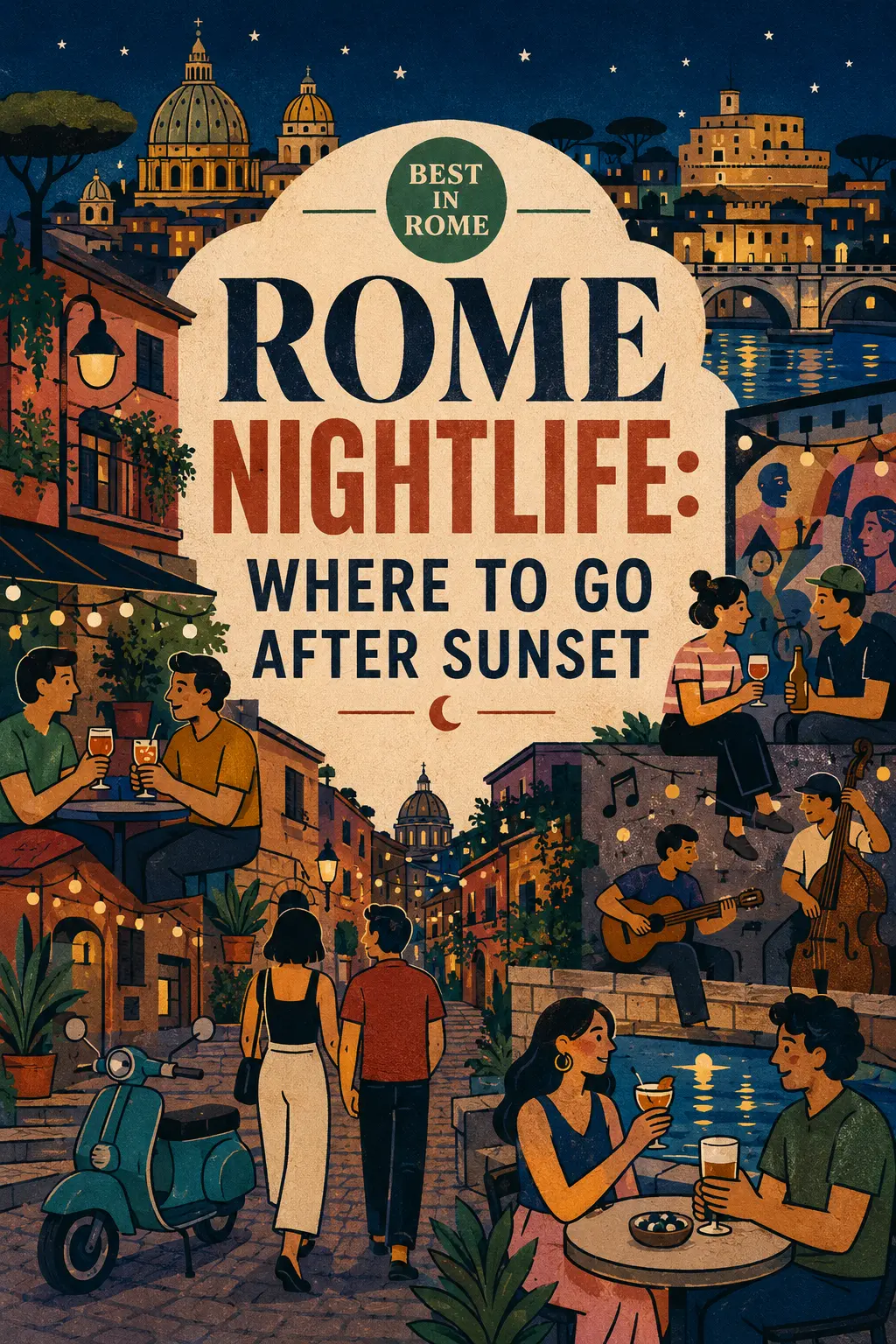

Rome does not have a nightlife problem. It has a geography problem. The city is enormous, every neighborhood has its own rhythm, and most tourist guides describe the same three squares while ignoring everything else.
I was born here. What follows is how Romans actually spend their evenings, broken down by area, by type of night, and by what to realistically expect. No cover charges, no velvet ropes, no recycled lists.
One thing to know before anything else: Rome runs late. Dinner starts at 8:30 or 9pm, aperitivo from around 6:30 to 8:30. If you show up at a bar at 9pm expecting a crowd, you will be disappointed. Come back at 11pm.
Trastevere: the Classic, and It Earns the Reputation
Trastevere is the neighborhood most visitors picture when they think of Roman nightlife, and for once the reputation is deserved. After dark the cobblestone streets fill up completely, Romans and tourists mixed together in a way that actually works, and the energy builds slowly from aperitivo through to the early hours.
The center of gravity is Piazza Trilussa. On warm evenings the steps of the fountain become an informal gathering spot where people sit with a beer or a bottle of wine bought from a nearby alimentari and talk for hours. It is one of the most genuinely Roman things you can do in the city and it costs almost nothing.
For a proper aperitivo with a seat and a cocktail, Meccanismo at Piazza Trilussa 34 is the reference point. It is the evolution of the legendary Café Friends, which essentially introduced the Milanese-style aperitivo to Rome in the early 2000s. The cocktails are well made, the small plates are good, and the location on the piazza makes people-watching unavoidable. Open daily from morning until late.
For craft beer, Ma Che Siete Venuti a Fa’ on Via Benedetta is two minutes from the piazza and has been the most respected craft beer bar in Rome for years. Already covered in the craft beer guide, but worth repeating: if you drink good beer, this is a must.
Freni e Frizioni on Via del Politeama has a loyal following for its generous aperitivo buffet and its outdoor terrace which spills onto the street every evening from around 6:30pm. It gets loud and crowded but the energy is good.
Trastevere works best if you walk it. Start with aperitivo, have dinner in one of the trattorie down the smaller side streets away from the main tourist flow, then drift from bar to bar until it feels like time to leave or stay.
Campo de’ Fiori Area: International, Open Late
The zone between Campo de’ Fiori and Piazza Navona is more international and more polished than Trastevere. Campo de’ Fiori itself gets noisy and student-heavy on weekend evenings, which is fine if that is what you want. The side streets around it are where things get more interesting.
Bar del Fico on Via della Pace 34, a short walk from Piazza Navona, is one of the most complete bars in central Rome. It opened as a latteria a century ago on the piazza named after a fig tree that once stood there, and it has been a neighborhood institution in various forms ever since. Today it runs from morning to 2am, covering breakfast, lunch, aperitivo, dinner and late-night drinks without losing quality at any stage. The outdoor tables under the trees are the draw in summer. The cocktail list is serious.
The area around Piazza Navona is better for an evening stroll and a late drink than for a full night out. The piazza itself, lit at night with Bernini’s fountains, is best experienced briefly and then left. The nearby streets reward wandering.
Flaminia and the Auditorium: Local, Underrated
Most tourists never come north on Via Flaminia. Romans who live in Parioli and Flaminio do, and the area has a different character from the historic centre: quieter, more residential, with a few spots that have built genuine local followings.
Tree Bar on Via Flaminia 226 is the best of them. It was built inside a renovated kiosk surrounded by a small park, with Nordic-influenced architecture in wood and glass that feels different from anything else in Rome. Craft beers on tap, cocktails, seasonal food, outdoor seating in the park with a fountain nearby. Monday evenings in the warm months there is “We Like Monday,” an aperitivo with a generous buffet and vinyl records. Open Tuesday to Sunday from noon to 2am, closed Monday.
Particularly useful before or after a concert at the Auditorium Parco della Musica, which is a few minutes’ walk away and has a year-round programme of classical music, jazz, and contemporary acts.
Tor di Quinto: When You Want Something Different
On the northern edge of the city, where the Tiber bends near the Ponte Milvio, the Parco di Tor di Quinto was for years a neglected area. It has been entirely redeveloped and is now home to QVINTO, a lounge restaurant set in the park with a lake, outdoor spaces, multiple rooms and gardens, and a scale that makes it unlike anything in the centre.
It is not a place for a spontaneous night out. It works as a destination, particularly for groups who want a dinner or an evening in a setting that is genuinely scenic and uncrowded. The spaces include a rooftop, a secret garden, a jungle garden and a private lounge. The park around it is green and quiet and very far from the cobblestones of Trastevere.
Address: Via Fornaci di Tor di Quinto 10. Booking strongly recommended at qvintoroma.it.
Pigneto: Rome’s Alternative Scene
Pigneto is the neighborhood that came up in the last fifteen years as the alternative to Trastevere’s increasingly commercial character. The area around Via del Pigneto has a creative, slightly rough-edged energy that draws a younger, local crowd: independent bars with craft beer and natural wine, aperitivo in the street, music that comes from inside the bars rather than from a DJ in a velvet-curtained club.
The formula in Pigneto is simple. You find a bar you like, order something, and stand on the street or sit on whatever surface is available. Nobody is trying to sell you a table. The bars are small, the prices are honest, and the crowd is genuinely Roman rather than international.
There is no single address to give because the neighborhood changes constantly. Walk along Via del Pigneto from the railway bridge toward Piazza dei Condottieri, and you will find it. The best evenings start around 7pm for aperitivo and develop slowly.
Tiburtina Area: Live Music and Culture
Two of Rome’s best live music venues sit near Stazione Tiburtina, in a part of the city that most visitors never reach.
Monk on Via Giuseppe Mirri 35 takes its name from the pianist Thelonious Monk, which tells you something about its intentions. It was originally the home of La Palma Club between 1995 and 2007, one of Rome’s most important jazz and world music venues, closed for seven years and then reopened in 2014 as a cultural space with indoor and outdoor areas. The programme covers concerts, DJ sets, festivals, workshops and theatre across multiple stages. Open and inclusive, it genuinely serves a local rather than commercial audience. Check monkroma.it for the programme.
Largo Venue on Via Biordo Michelotti 2 describes itself as a total club between the Prenestina and paradise, which is an accurate description of both its location and its ambitions. A former industrial space transformed into a concert venue and club with a garden, it programmes new Italian and international music alongside DJ nights and community events. Close to San Lorenzo and the Pigneto area. Check largovenue.com for the calendar.
Both venues work by programme, not by fixed opening hours. Check before you go.
Summer: Parco Appio and the Estate Romana
Rome in summer empties of Romans and fills with tourists, which means the locals who stay find other places to be. The Estate Romana programme runs from June through September with outdoor events, screenings, and concerts across the city.
Parco Appio on Via dell’Almone 105, near the Fonte Egeria and the Appia Antica, is the summer spot that Romans return to year after year. The park in front of the ancient spring is transformed into an open-air venue with food, craft beer, cocktails, pizza, music and DJ sets. The atmosphere is relaxed, family-friendly in the early hours and more animated later. Open Monday to Wednesday 6pm to midnight, Thursday 6pm to 2am, Friday to Sunday noon to 2am.
It is exactly the kind of place that does not appear in tourist guides and is full of Romans.
A Few Practical Notes
On timing: aperitivo runs 6:30 to 8:30pm. Dinner from 8:30 to 10pm. Bars fill up from 10:30pm onward. Clubs barely start before midnight. Romans usually do one or two of these things per evening, not all four.
On transport: the metro runs until 11:30pm Sunday to Thursday and until 1:30am on Friday and Saturday. Night buses cover most of the city from midnight onward but run infrequently. Taxis or a rideshare app are the most reliable option after midnight.
On dress code: Trastevere and Pigneto are genuinely casual. Monti and the Campo de’ Fiori area tend slightly smarter. QVINTO leans toward the dressy side. Nobody will refuse you entry for wearing trainers, but turning up to a dinner reservation in beachwear is another matter.
On safety: Rome at night is generally safe. The main areas to be aware of for bag security are Termini station and its immediate surroundings, and the most crowded tourist areas late at night. The neighborhoods in this guide are all fine to walk through at any hour.
All practical information verified in May 2026. Opening hours and programmes change, always check directly with the venue before you go. None of the places in this guide are sponsored or paid placements. These are personal recommendations from a Roman who was born and raised in this city and has no commercial relationship with any of the venues listed. Just someone who goes out in Rome and has opinions about it.
Leave a Reply