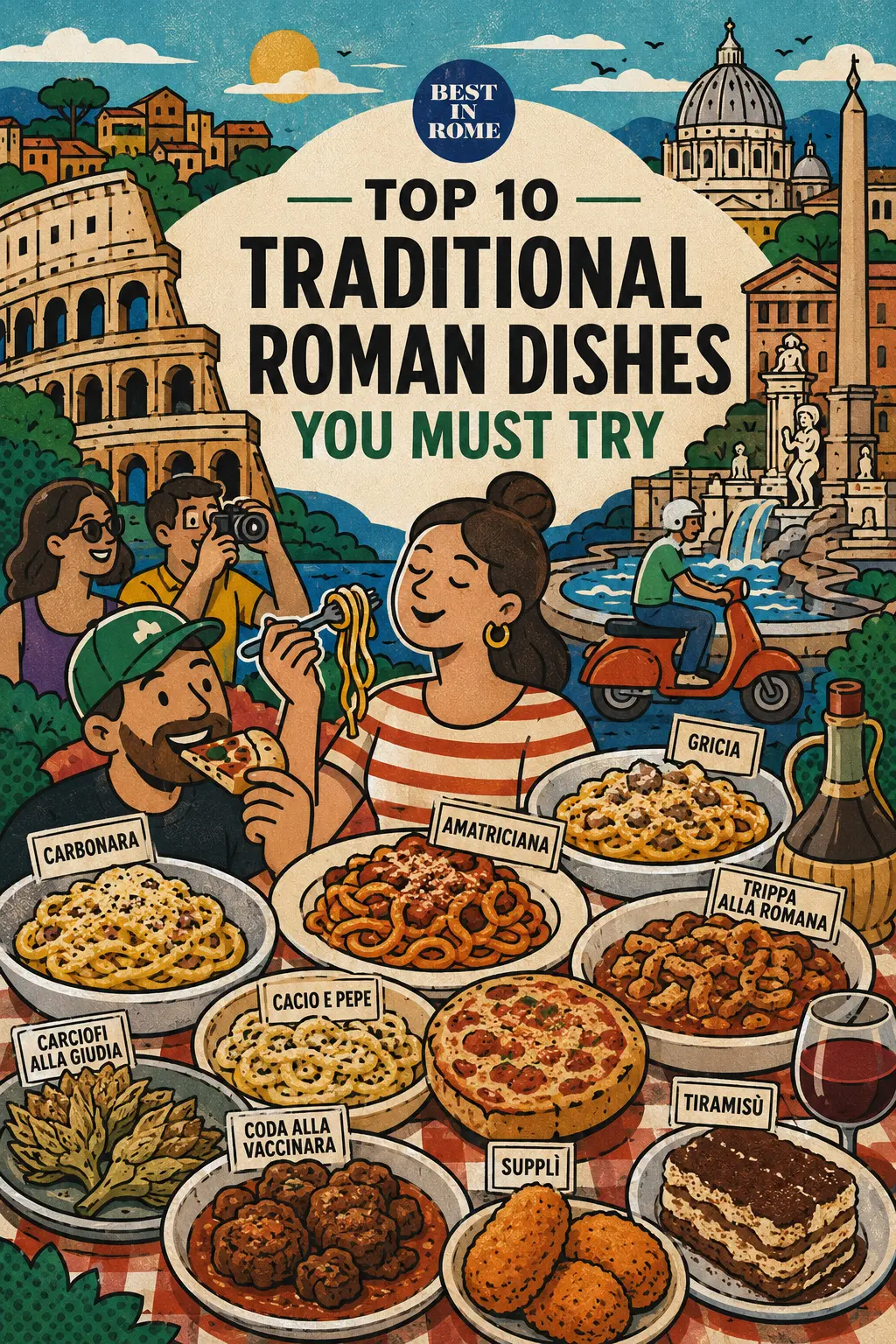

When in Rome, eat like a Roman.
Roman cuisine is one of the oldest continuously evolving food traditions in the world. It did not emerge from royal kitchens or from the imagination of professional chefs. It came from the streets, the markets, the slaughterhouse workers of Testaccio, the Jewish community of the Ghetto, the farmers of the surrounding countryside. The ingredients were cheap. The techniques were simple. The results, over centuries of refinement, became some of the most recognizable dishes in Italy.
What makes Roman food Roman is not just the recipes but the relationship between the city and its ingredients. Guanciale from the pigs of the Castelli Romani. Pecorino from the sheep of the Lazio hills. Artichokes from the fields between Rome and the sea. Abbacchio from the pastures of the surrounding countryside. The land around Rome feeds the city in ways that have not fundamentally changed in two thousand years.
These are the ten dishes that express this tradition most directly. Not the most refined or the most elaborate, but the most Roman.
One thing worth knowing before you start: if a restaurant is genuinely Roman, nobody at the table will be drinking a spritz with these dishes. Wine, yes. Water, always. A spritz is an aperitivo, served before food, not alongside it. Order one beforehand if you like, but when the pasta arrives it goes.
1. Carbonara
Carbonara is probably the most misunderstood pasta in the world. Outside Rome it arrives at the table swimming in cream, sometimes with peas, occasionally with mushrooms. Inside Rome, none of these things exist. Authentic carbonara contains exactly five ingredients: pasta (rigatoni or spaghetti), guanciale, pecorino Romano, egg yolks, and black pepper. The creamy texture comes entirely from the emulsion of eggs and cheese, worked off the heat so the eggs do not scramble.
The details matter: guanciale, not pancetta or bacon. Pecorino, not Parmesan (though some Romans use a blend). Rigatoni or spaghetti, not penne or fusilli. Black pepper, freshly ground and generous. If your carbonara arrives with cream, you are in the wrong restaurant. Leave politely and try again.
Where to eat it: Roscioli, Via dei Giubbonari 21-22, near Campo de’ Fiori. Open Monday to Saturday 12:30-15:30 and 19:00-23:30, closed Sunday. Booking recommended. Or Da Enzo al 29, Via dei Vascellari 29, Trastevere.
2. Amatriciana
Amatriciana comes from the town of Amatrice in the Apennine mountains east of Rome, which is technically in Lazio and considers it their own. Rome adopted it and perfected it over centuries. The dish is bucatini or rigatoni with guanciale, tomato sauce, pecorino Romano and a little white wine. No onion, no garlic, no herbs.
The debate between bucatini and rigatoni is the kind of argument Romans have seriously, with positions passed down through families. Bucatini is traditional. Rigatoni holds the sauce differently. Both are correct. The wrong answer is spaghetti.
Where to eat it: Armando al Pantheon, Salita dei Crescenzi 31, open Monday to Friday 12:30-14:30 and 19:00-22:30, Saturday lunch only, closed Sunday. Book well in advance. Or Trattoria Da Teo, Piazza dei Ponziani 7A, Trastevere, open Monday to Saturday for lunch and dinner, closed Sunday.
3. Cacio e Pepe
Cacio e pepe looks like the simplest dish on this list. It contains three ingredients: pasta (tonnarelli or spaghetti), pecorino Romano and black pepper. In practice it is one of the hardest Roman dishes to execute correctly. The pecorino must be incorporated off the heat with pasta water to form a smooth, creamy sauce that coats the pasta without clumping. Too hot and it becomes stringy. Too much water and it becomes soup. The balance requires technique that takes years to develop.
Order it at a restaurant where you can see it being made. A properly executed cacio e pepe should arrive as a coherent whole, each strand coated in a thin film of cheese with visible pieces of cracked pepper throughout.
Where to eat it: Felice a Testaccio, Via Mastro Giorgio 29, Testaccio. Open Monday to Sunday 12:30-15:00 and 19:00-23:30. Their cacio e pepe has been considered a benchmark in Rome for decades.
4. Gricia
Gricia predates both carbonara and amatriciana and is, in a sense, the origin of both. It is guanciale, pecorino Romano and black pepper, with pasta, and nothing else. No eggs, no tomato. Pure.
Because there is nowhere to hide in gricia, the quality of the guanciale becomes the determining factor. Good guanciale has fat that renders slowly and becomes silky rather than greasy. The result is a dish that is more complex in flavour than its ingredient list suggests, and which demonstrates better than almost anything else what Roman cooking can do with almost nothing.
Where to eat it: Osteria Angelino dal 1899, Via Capo d’Africa 6, near the Colosseum. Or Flavio al Velavevodetto, Via di Monte Testaccio 97, Testaccio.
5. Supplì
Supplì are fried rice balls, filled with ragù and mozzarella, breaded and deep-fried until the exterior is dark and crisp. Break one open and the mozzarella stretches between the two halves: the effect gave them their full name, supplì al telefono, after the telephone cord they resemble.
They are Roman street food in its most essential form: cheap, hot, eaten standing up, available from rosticcerie and market stalls all over the city. The best ones have a pronounced crust and a ragù that is genuinely well-seasoned. The worst ones are pale, soft and lukewarm. There is a significant difference.
Where to eat them: Supplizio, Via dei Banchi Vecchi 143, near Campo de’ Fiori. Open Monday to Saturday 12:00-15:30 and 17:00-22:00, closed Sunday. Or I Supplì, Via di San Francesco a Ripa 137, Trastevere.
6. Saltimbocca alla Romana
Saltimbocca means “jump in the mouth,” which describes the intent of the dish rather than any preparation technique. It is thin veal escalopes topped with prosciutto crudo and a sage leaf, secured with a toothpick and cooked in butter and white wine until the veal is tender and the prosciutto has slightly crisped at the edges.
The name is the brief: it should be good enough to eat fast, without pausing. A properly made saltimbocca is one of the most straightforward and satisfying things in the Roman canon. The veal must be thin, the prosciutto must be quality, and the sage must be fresh.
Where to eat it: Ristorante Saltimbocca, Via di Tor Millina 5, a few hundred metres from Piazza Navona. Specialises in the dish it is named after. Open Monday to Friday 17:00-02:00, Saturday and Sunday 11:00-02:00.
7. Carciofi alla Giudia
The Jewish Ghetto of Rome has been continuously inhabited for over two thousand years and has contributed several dishes to the Roman canon, of which carciofi alla giudia is the most famous. The artichoke is cleaned, beaten against a hard surface to open the leaves like a flower, then deep-fried twice: once at lower temperature to cook through, once at high temperature to crisp the leaves to crackling. The result looks improbable and tastes extraordinary.
The artichoke variety matters: only the romanesco mammola, a round spineless artichoke grown in the fields between Rome and the sea, has the right density and flavour for this dish. It is available from late winter through spring. In summer you will not find it, or what you find will be wrong.
Where to eat it: Ba’Ghetto, Via del Portico d’Ottavia 57, in the heart of the Jewish Ghetto. The reference address for this dish in Rome.
8. Trippa alla Romana
Tripe in a rich tomato sauce, flavoured with mint and finished with pecorino Romano. This is the dish that most clearly expresses the cucina del quinto quarto, the fifth quarter, the offal-based cooking tradition that emerged from the working-class neighbourhood of Testaccio in the 19th century. The workers at the slaughterhouse were paid partly in the cuts of meat the wealthier classes did not want. They made something extraordinary with them.
Traditionally eaten on Saturdays in Rome, which is when trattorie in Testaccio still feature it most prominently on the menu. If you are not accustomed to eating offal, this is a reasonable place to start: the tomato sauce and the mint make it accessible while the texture and depth of flavour make it memorable.
Where to eat it: Checchino dal 1887, Via di Monte Testaccio 30, Testaccio. Has been serving this dish according to the same family recipe since 1887.
9. Abbacchio alla Scottadito
Abbacchio is milk-fed lamb, and it has been central to Roman cooking since the time of the ancient Romans. Scottadito, meaning “burn your fingers,” refers to the instruction to eat the grilled chops directly with your hands, hot from the grill, without waiting for them to cool. The seasoning is minimal: olive oil, salt, rosemary, sometimes a little garlic. The lamb does the rest.
It is a seasonal dish, best from autumn through spring, and particularly associated with Easter in Rome. In summer the quality of the lamb is not the same and most serious restaurants do not serve it. If you are in Rome in March or April, this is the moment to eat it.
Where to eat it: Checchino dal 1887, Via di Monte Testaccio 30, which serves three versions of abbacchio. Or Antica Pesa, Via Garibaldi 18, Trastevere.
10. Maritozzo con la Panna
Rome’s breakfast institution: a soft brioche bun, sliced horizontally and filled with whipped cream to a height that seems structurally improbable. The maritozzo is eaten standing at the bar with a cappuccino, ideally before 10am. The combination of the slightly sweet bread and the cold, dense cream is a specific pleasure that is worth seeking out even if you do not normally eat pastry for breakfast.
The name has two possible origins, both involving men bringing these to women they were courting. Neither story is fully verifiable. The bun is good regardless.
Where to eat it: Regoli Pasticceria, Via dello Statuto 60, near Termini, open since 1916. Open Monday and Wednesday to Sunday 6:30-20:30, closed Tuesday.
A Note on Where to Eat in Rome
The restaurants listed above are not advertisements. They are places with long track records of serving these dishes correctly. That said, Rome has thousands of good restaurants and the ones on this list are not the only options.
Two signs that a Roman restaurant is worth trusting: the menu is short and changes with the season, and the wine list is mostly local. Two signs that it is not: photographs of the dishes on the menu, and a front-of-house person stationed outside to invite you in.
All restaurant information verified in May 2026. Always check opening hours before visiting, as many Roman restaurants close one day per week and some close for part of August.
✨ Discover Rome at its best — one dish at a time.
Leave a Reply