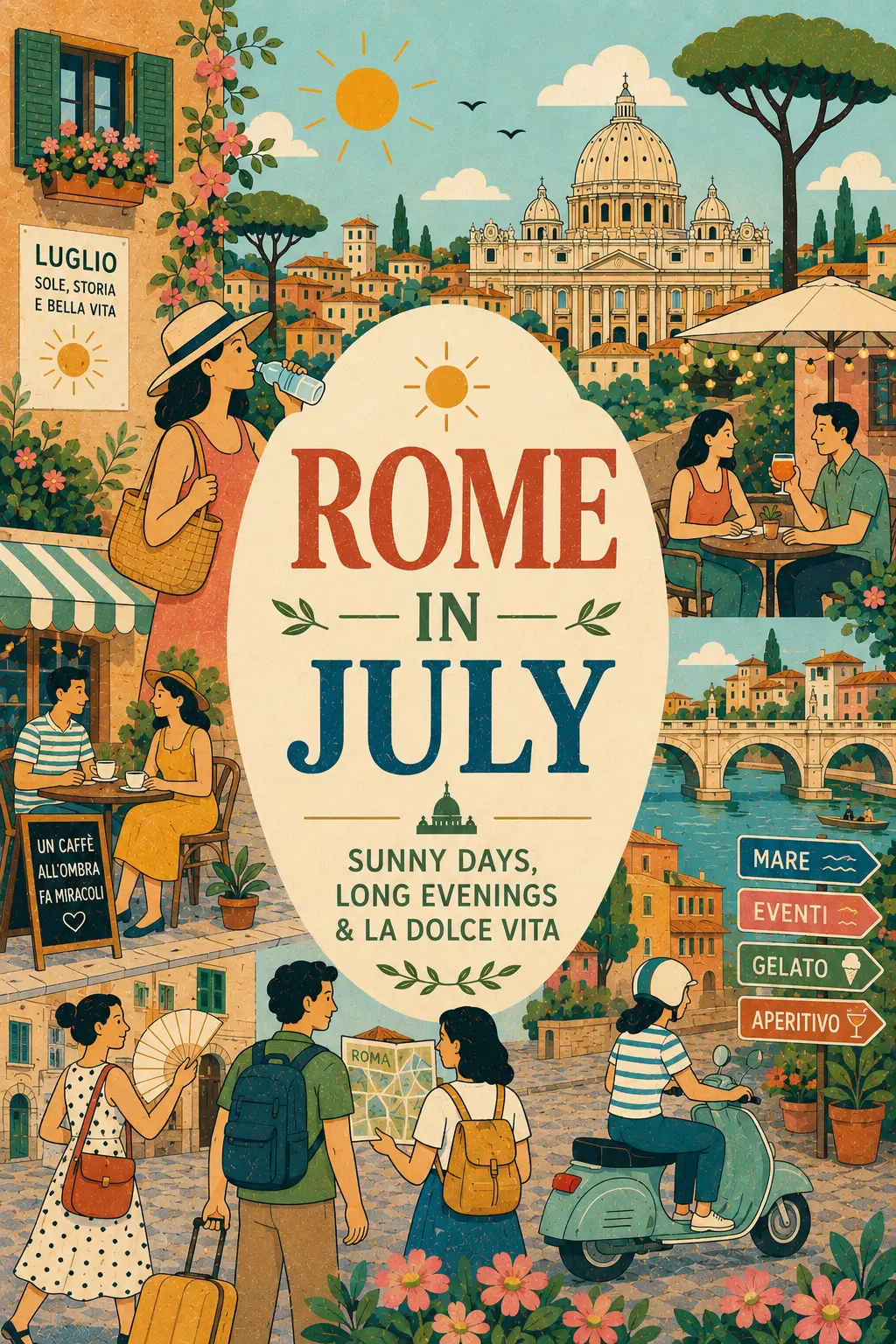

Let me be honest with you from the start: July in Rome is hot. Not “bring a light jacket for the evening” hot. Proper, Mediterranean, the-asphalt-is-softening hot. Every year I watch tourists marching up to the Roman Forum at 2 PM in full sun, and every year I want to run over with a bottle of water and an intervention.
But here’s the thing nobody tells you: July is also one of the best months to be in Rome, if you do it the way we do it. The city changes completely after sunset. Romans basically become nocturnal in summer, and the whole city follows: festivals along the river, opera under the stars, dinners that start at 9 PM and end whenever. You just need to flip your schedule.
So this is my guide to Rome in July. Not the generic “visit the Colosseum” list, but how someone born and raised here actually lives this month.
The Golden Rule: Mornings and Evenings Only
If you remember one thing from this article, make it this: in July, Rome is a city of mornings and evenings. The middle of the day belongs to air conditioning, long lunches, and naps. Fighting this is how vacations get ruined.
Here’s the rhythm that works:
8:00 to 11:00 AM: This is your window for the big outdoor sites. The Colosseum, the Forum, the Palatine, Ostia Antica if you’re feeling adventurous. Book the earliest entry slot you can find. At 8:30 AM the Colosseum is almost pleasant. At 1 PM it’s a frying pan with arches.
12:00 to 5:00 PM: Museums with air conditioning. The Vatican Museums, Galleria Borghese, Palazzo Massimo (criminally underrated, by the way, and never crowded). Or do what Romans do: a long lunch somewhere cool, then absolutely nothing. Nothing is a legitimate activity in a Roman July.
After 7:00 PM: The city comes back to life, and this is when July Rome becomes magical. Sunset walks, aperitivo, dinner outside, and the summer festivals I’m about to tell you about.
One more thing: the light in July is spectacular in the evening. If you want photos of the Fori Imperiali or a view over the rooftops, golden hour is your friend. I’ve written a whole article about the best views in Rome, and almost all of them are better in July at 8 PM than at any other time of year.
Estate Romana: The City Becomes One Big Open-Air Festival
Every summer, Rome runs a city-wide program called Estate Romana (literally “Roman Summer”). It’s been going since the 1970s and it covers everything: open-air cinema, concerts, theater, book festivals, all spread across piazzas, parks, and archaeological sites. Most events are free or cheap.
The heart of it, for me, is the Lungo il Tevere festival. Both banks of the Tiber around Tiber Island fill up with stalls, bars, restaurants, live music, and an open-air cinema on the island itself (Isola del Cinema). It runs every evening from around 7 PM until 2 AM, from June until late August. Entry is free.
Is part of it touristy? Sure. But Romans genuinely go, especially on weeknights. My advice: walk the whole stretch once, pick a bar with a view of the water, and settle in. The river breeze at midnight is one of the few free forms of air conditioning this city offers.
Festa de’ Noantri: Trastevere’s Big Week
If you’re in Rome in the second half of July, you get to see something most tourists walk right past without understanding: the Festa de’ Noantri, Trastevere’s festival.
The name means “the festival of us others,” which tells you everything about how Trastevere sees itself compared to the rest of Rome. It’s dedicated to the Madonna del Carmine, a wooden statue of the Virgin Mary that, according to tradition, fishermen found at the mouth of the Tiber in the 1500s. Once a year, and only once a year, the statue leaves its church and is carried in procession through the streets of the neighborhood.
Around the religious core, there’s a full week of free events: concerts, theater, cabaret, and street performances in Piazza Santa Maria in Trastevere and the surrounding alleys. In 2026 it runs from July 17 to 25.
My honest take as a Roman: go for the procession if you can catch it. It’s one of the few moments where Trastevere stops being an open-air restaurant for tourists and goes back to being a rione, a real neighborhood, with grandmothers on balconies and confraternities in robes. It’s genuinely moving, even if you’re not religious.
Opera and Concerts Under the Stars
Rome’s summer concert scene is seriously underrated. While everyone associates the city with ancient stones, July nights here are full of music.
The big one is the summer season of the Teatro dell’Opera di Roma. For decades it has been staged among the ruins of the Baths of Caracalla, which is one of the most spectacular settings for opera anywhere in the world. In 2026, with the Baths under restoration, the whole festival has moved to the Circus Maximus: opera, ballet, and film-with-live-orchestra events from late June through July 31, with tickets starting around 15 euros. Yes, you read that right: opera at the Circus Maximus, where the Romans held chariot races, for the price of two spritzes in Trastevere.
Beyond the opera, July also brings Rock in Roma (big international acts at the Capannelle racetrack) and Roma Summer Fest at the Auditorium Parco della Musica. Whatever your taste, there’s a stage for it.
Pro tip from experience: outdoor shows here start at 9 PM or later, so plan dinner before or make it a late one after. Both are perfectly Roman choices.
Surviving the Heat Like a Roman
A few survival rules that we all follow without even thinking about them:
Drink from the nasoni. Rome has thousands of free public drinking fountains with cold, excellent water. Refill your bottle constantly. I wrote a full guide to the nasoni because I genuinely believe they’re one of Rome’s best features.
Learn the word grattachecca. It’s shaved ice with fruit syrup, sold at kiosks that have been run by the same families for generations, mostly near the river. It is not a granita and do not call it one in front of the vendor. It’s the most Roman way to cool down that exists.
Gelato is a meal. In July, a 4 PM gelato is not a snack, it’s a survival strategy. If you want to know where I actually go, and where I’d never set foot, my gelato guide is here.
Eat late, eat light at lunch. Nobody here has carbonara at noon in July. Lunch is something cold and fast; dinner is the main event, outside, after 8:30 PM.
Walk in the shade. This sounds obvious, but Romans have entire mental maps of which side of which street is shaded at which hour. Via dei Coronari in the morning, the east side of Via del Corso in the afternoon. You’ll develop this instinct within two days.
Is July a Good Time to Visit Rome?
Here’s my honest answer: yes, if you accept the deal Rome offers you in July. The deal is this: you surrender the middle of the day, and in exchange you get long golden evenings, a city full of open-air festivals, opera in ancient ruins, and dinners that stretch past midnight under the plane trees.
If your dream trip is power-walking through fifteen monuments a day, come in April or October instead. But if you’re willing to slow down and live on Roman summer time, July might just be the version of Rome that stays with you longest.
And if you need help with the basics, start with my guides on getting around Rome without getting scammed and where to find the city’s best nightlife, neighborhood by neighborhood.
See you by the river.
Leave a Reply