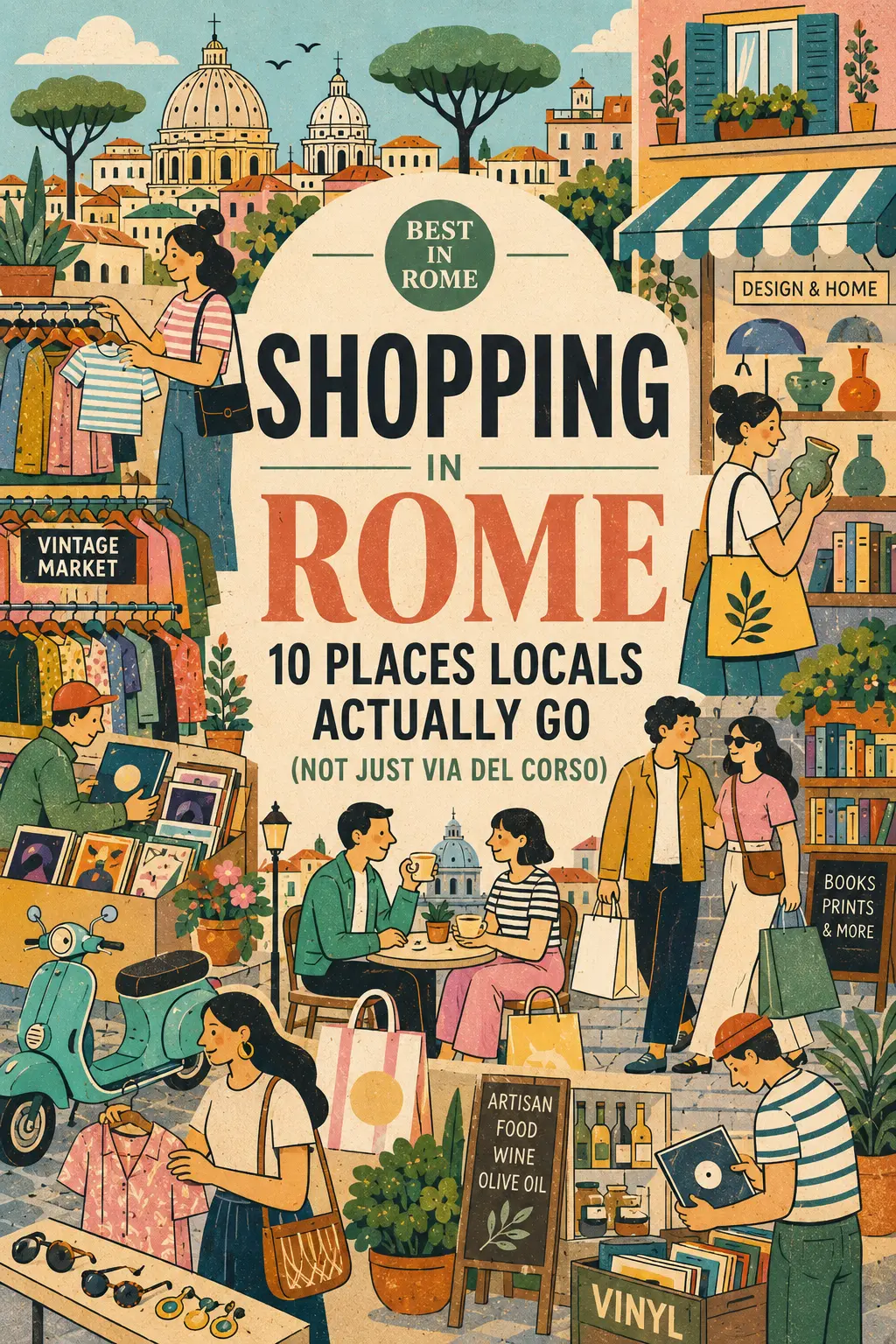

Romans are not great shoppers by nature. They would rather spend two hours at a table than two hours in a shop. But when they do shop, they know exactly where to go, and it is almost never Via del Corso.
Rome has a layer of commercial life that most tourists miss entirely: the vintage markets of Monti, the food shops of Testaccio, the antique dealers of Via dei Coronari, the Sunday morning ritual of Porta Portese. These are not hidden secrets. They are simply the places where people who live here actually spend their money.
This is that list.
Vintage and Second Hand
Pifebo Vintage Shop — Monti and Trastevere
Pifebo is the reference point for vintage clothing in Rome. It has been building its following for years with a carefully curated selection of second-hand clothing, accessories and eyewear, and now has three locations in the city and an online shop with 59,000 followers on Instagram. The main location on Via dei Serpenti 135/136 in Monti is the most complete, spread across two floors with a selection that covers everything from Levi’s denim and leather bags to vintage sportswear and deadstock eyewear. The Trastevere location at Via di San Francesco a Ripa 131 is smaller but equally well organised.
What sets Pifebo apart from the generic second-hand shop is the curation. Everything is cleaned, categorised and priced clearly. It is not cheap by thrift shop standards, but the selection is genuinely good and the turnover is fast enough that regular visitors always find something new.
Open Monday to Saturday 11:00-20:00, closed Sunday. Via dei Serpenti 135/136, Monti. Also at Via di San Francesco a Ripa 131, Trastevere.
King Size Vintage — Monti
King Size Vintage sits a few doors from Pifebo on Via dei Serpenti and is consistently cited alongside it as one of the best vintage shops in the city. The emphasis here is on larger-scale pieces and a more eclectic selection: military surplus, workwear, sportswear, accessories. The two shops are complementary rather than competitive and most serious vintage shoppers visit both in the same outing.
Via dei Serpenti, Monti. Opening hours vary, check directly before visiting.
Porta Portese — Trastevere (Sunday only)
Porta Portese is Rome’s Sunday flea market and one of the oldest in Europe. It runs from early morning until 2pm along Via Portese and the surrounding streets in the Trastevere area, with hundreds of vendors selling everything from genuine antiques and vintage clothing to books, records, tools, plants, and objects of indeterminate origin and purpose.
The quality varies enormously. There are serious dealers with real finds and there are vendors selling things that should have been thrown away. The experience is the point: the crowd, the noise, the negotiation, the occasional genuine discovery. Go early, before 8am, if you want first pick and a manageable crowd. Go after 10am if you want the full Roman Sunday morning atmosphere.
Free to enter. Via Portese, Trastevere. Every Sunday 6:00-14:00. Metro B to Garbatella or bus 8 to Trastevere.
Independent Shops and Design
Mercato Monti — Monti (weekends only)
Mercato Monti is a weekend market for independent Roman designers and vintage dealers, held inside the Grand Hotel Palatino on Via Leonina 46 in the Monti neighbourhood. It runs every Saturday and Sunday from September to June, 10:00-20:00, and brings together around 80 stalls of clothing, accessories, objects and small-batch design work from mostly Roman and Italian producers.
It is the right kind of market: edited rather than sprawling, with a consistent level of quality that makes it worth visiting even without a specific purchase in mind. The neighbourhood around it, with Via dei Serpenti, Via del Boschetto and Via Urbana all within a five-minute walk, makes a full morning of independent shopping straightforward. Monti is also home to some of the best hidden gems in Rome if you want to make a full day of it.
Via Leonina 46, Monti. Saturday and Sunday 10:00-20:00, September to June. Metro B, Cavour stop.
Celadon Roma — Monti
Celadon is a small ceramics studio and shop run by Cecilia Ariaudo and Paola Cenciarelli, producing handmade pieces in pastel colours and elegant forms. Cups, bowls, vases, plates: everything is made by hand and everything is distinctive in a way that mass-produced homeware is not. They also run workshops in Centocelle where you can make your own piece.
It is the kind of shop that does not exist in every city, and the kind of object that is actually worth carrying home in your luggage. Via del Boschetto area, Monti.
Fabriano Boutique — Via del Babuino
Fabriano is a small town in the Marche hills that has been producing paper since 1264, supplying the Vatican, the Bank of England and artists across Europe. The boutique on Via del Babuino 173, a few steps from Piazza di Spagna, is the full expression of that tradition: notebooks, travel journals, artist sketchbooks, fountain pens, watercolour sets and stationery of a quality that makes most paper shops look careless by comparison.
It is the kind of place where buying a notebook feels like a considered decision rather than a transaction. If you need to bring something Italian home that is not food or fashion, this is the answer.
Open Monday 15:00-19:00, Tuesday to Saturday 10:30-19:00, closed Sunday. Via del Babuino 173, near Piazza di Spagna.
Via dei Coronari — The Antique Dealers’ Street
Via dei Coronari runs for about 500 metres between Largo di Tor Sanguigna and Piazza dei Coronari, a few minutes’ walk from Piazza Navona. It is one of the most beautiful streets in Rome in purely architectural terms, lined with 15th and 16th-century buildings, and it has been the street of antique dealers and art galleries for decades.
The shops vary: some are serious dealers in period furniture, paintings and objects from the 17th and 18th centuries; others carry a more accessible mix of vintage objects, jewellery and collectibles. The quality of the street itself rewards a slow walk regardless of whether you intend to buy anything. For serious antique hunters, the Mostra dell’Antiquariato, held twice a year in spring and autumn, turns the whole street into an open-air market.
Free to walk. Near Piazza Navona, Rione Ponte.
Via Margutta — Historic Centre
Via Margutta, a narrow street running parallel to Via del Corso between Piazza di Spagna and Piazza del Popolo, has been the street of artists and galleries in Rome since the 19th century. Fellini lived here. Today it is lined with art galleries, antique dealers, artist studios and a handful of shops that would not exist anywhere else in the city. It is not a street for buying things you need but for finding things you did not know you wanted.
Worth a slow walk at any time, but particularly on spring and autumn Sundays when the art market along the street is active.
Food Shopping
Salumeria Roscioli — Historic Centre
Roscioli is the most famous delicatessen in Rome and one of the best in Italy. The family has been in the food business since 1972, and the salumeria on Via dei Giubbonari 21 carries over 150 varieties of cured meats, more than 350 types of cheese, and a wine cellar with around 2,800 labels. It also doubles as a wine bar and restaurant with a Michelin recommendation.
For taking things home: the selection of Italian regional products is extraordinary. Guanciale, aged pecorino from various producers, bottarga, conserves, pasta, oil. The staff know their products with a depth that is unusual even in Italy. Many of the products you will find here are also the ingredients behind Rome’s greatest pasta dishes. If you have read our guide to traditional Roman food, you will recognise the names.
Open Monday to Saturday 7:00-23:30, closed Sunday. Via dei Giubbonari 21, near Campo de’ Fiori.
Volpetti — Testaccio
Volpetti has been on Via Marmorata in Testaccio since 1973 and is considered by many Romans the finest gastronomia in the city. The Volpetti brothers, originally from Norcia in Umbria, built the shop around an obsessive attention to ingredient selection: every product on the shelves has been chosen personally, from artisanal producers across Italy and beyond.
They also have a trattoria around the corner where you can eat lunch from ingredients sourced directly from the shop. Testaccio itself is one of the most interesting neighbourhoods in Rome for food. If you are spending time in the area, the Mercato Testaccio is worth combining with a visit to Volpetti in the same morning.
Open Monday 9:00-14:00, Tuesday to Saturday 9:00-14:00 and 16:00-20:00, Sunday 9:00-14:00. Via Marmorata 47, Testaccio.
Department Stores and Luxury
La Rinascente — Via del Tritone
La Rinascente on Via del Tritone 61 is Rome’s most significant department store, stocking a mix of international and Italian luxury brands across multiple floors. It covers everything in one building with a level of service and selection that is hard to match elsewhere in the city.
Two things worth knowing beyond the shopping: the building contains the visible remains of the ancient Aqua Vergine aqueduct, excavated during construction and now incorporated into the store’s lower levels. And the rooftop has an unobstructed view over the city’s rooftops toward the Trevi Fountain area. Both are free to see.
Open daily 10:00-22:00. Via del Tritone 61, near Fontana di Trevi.
Via Condotti and the Luxury Quarter
Via Condotti, running from Piazza di Spagna toward the historic centre, is Rome’s luxury shopping street. Gucci, Prada, Valentino, Bulgari, Louis Vuitton and most of the major Italian and international fashion houses have their Roman flagships here. The street itself is beautiful regardless of whether you intend to buy anything, and the buildings housing the boutiques are often 17th and 18th-century palazzi worth a look.
For a slightly different version: Via Borgognona and Via della Croce, both running parallel or perpendicular to Condotti, have a mix of luxury boutiques and independent Roman designers that is more interesting than the main street.
A Note on Shopping in Rome by Neighbourhood
The best shopping in Rome is organised by neighbourhood rather than by category. Monti (Metro B, Cavour stop) is the single most rewarding area. Via dei Serpenti, Via del Boschetto, Via Urbana and Via Panisperna together cover vintage, independent design, ceramics, jewellery and food in a 15-minute walking radius. Trastevere has creative boutiques and leather goods artisans, best explored on foot in the late afternoon. Testaccio is for food, full stop. Prati, on the Vatican side of the Tiber, has a more conventional but genuinely local high street that most tourists never see.
If you are spending a day moving between neighbourhoods, our guide to getting around Rome will help you navigate without overpaying for transport.
Via del Corso is fine for international chains. But you did not come to Rome for international chains.
All practical information verified in May 2026. Opening hours can change, always check directly before visiting.
Leave a Reply