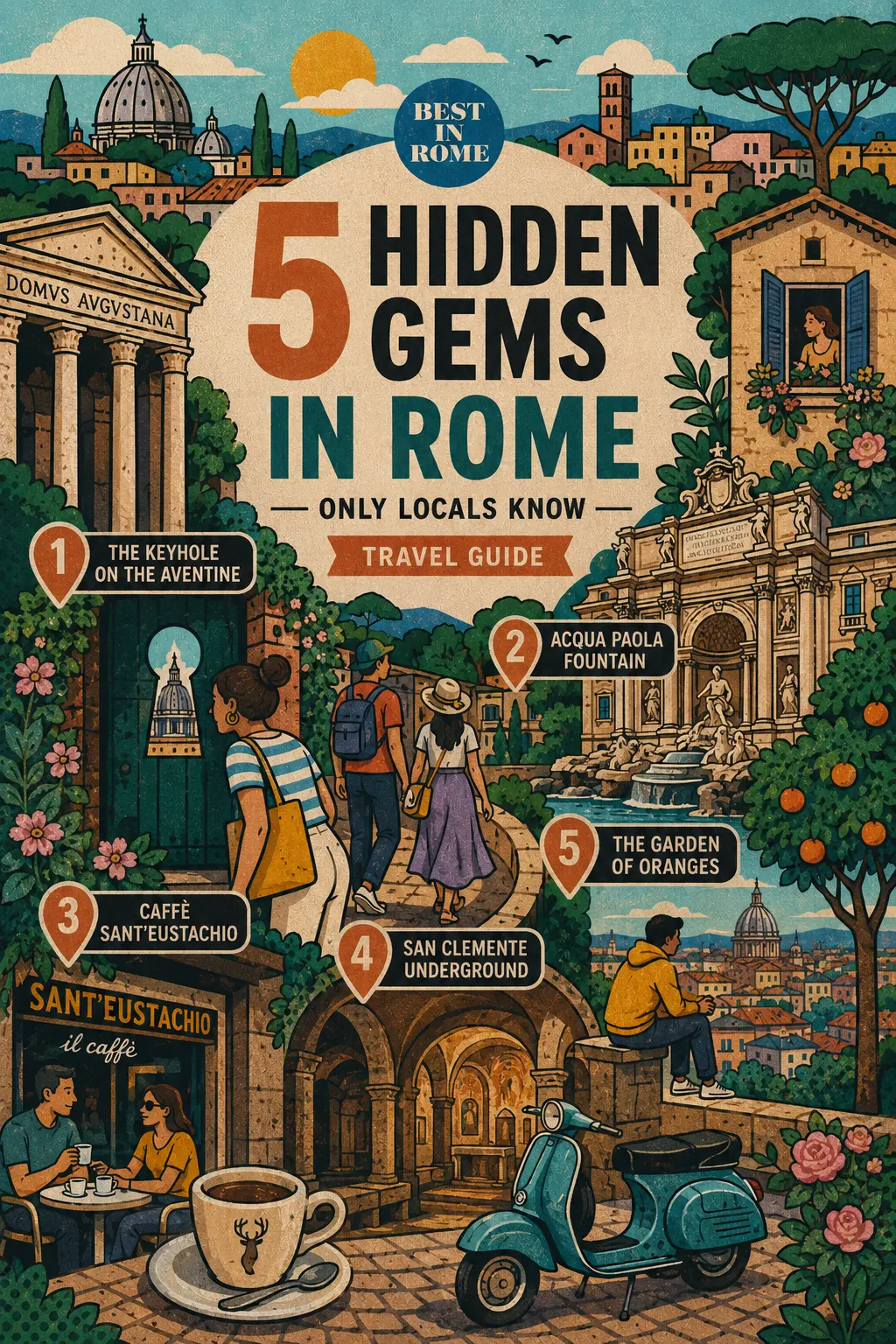

Most visitors to Rome follow the same route. Colosseum in the morning, Vatican in the afternoon, Trevi Fountain in the evening. It is a perfectly reasonable itinerary, and everything on it is worth seeing. But Rome is one of the deepest cities on earth, and the version most tourists see is the surface layer.
I was born and raised here. These are five places I actually go to, places I take friends when they visit and want to see something real. None of them require a ticket in advance. Most of them are free. None of them will have a queue.
1. The Coppedè District: Rome’s Secret Fairytale Quarter
Most people walk straight past Coppedè without realising it exists, which is extraordinary given how extraordinary it looks. This small neighbourhood in the Trieste district was designed between 1921 and 1926 by the Florentine architect Gino Coppedè, and it looks like nowhere else in Rome or Italy.
The style is impossible to categorise. Art Nouveau, Art Déco, medieval, baroque, ancient Greek, ancient Roman. Coppedè mixed everything without apology and the result is a quarter that feels like a film set. The entrance is a large archway on Via Dora with an elaborate wrought-iron chandelier hanging from it. Once you pass through, you are in a different city.
The centrepiece is the Fontana delle Rane, a fountain in the small piazza at the heart of the quarter. The surrounding villas, Villetta delle Fate, Palazzo del Ragno, Villa Allegra, each have their own extravagant personality. You will want to walk slowly and look up.
The area is entirely residential. People live here. The streets are quiet, there are no souvenir stands, and on a weekday morning you may have the whole quarter to yourself.
Getting there: Tram 19 to Piazza Buenos Aires, then 3 minutes on foot. Or bus 92 from Termini to Tagliamento/Clitunno, 2 minutes on foot. The entrance arch is on Via Dora, just off Via Tagliamento.
Practical info: free, accessible at any time.
2. Villa Torlonia: Where Romans Actually Go for a Picnic
While every tourist in Rome goes to Villa Borghese, Romans go to Villa Torlonia. The two parks have a very different scale, Villa Borghese is much larger, but Torlonia has something Borghese has somewhat lost under the weight of its own popularity: it still feels like a place where people live, not just visit.
The park covers 13 hectares of gardens, umbrella pines and historical buildings on Via Nomentana. It was once the private estate of the Torlonia family and later, more troublingly, the official residence of Benito Mussolini from 1925 to 1943. The bunker and anti-aircraft shelters he had built under the Casino Nobile are still there and can be visited on a guided tour with pre-booking. The contrast between the garden above and the concrete corridors below is genuinely disquieting.
But the main reason to come here is simpler than history: it is one of the best places in Rome to sit on a blanket under a pine tree and do nothing for an afternoon. Bring food from a nearby alimentari, arrive mid-morning before the families arrive, and settle in.
The thing most visitors miss is the Serra Moresca. This Moorish greenhouse, built in the mid-19th century with its distinctive horseshoe arches and Islamic-inspired ornamentation, is one of the strangest and most beautiful buildings in Rome. It sits at the edge of the park and is only open for limited hours, which is exactly why most people never see it.
Getting there: Bus 36, 84, 90, 92 to Via Nomentana. Main entrance at Via Nomentana 70.
Practical info: the park is free and open every day. The museums have separate tickets per building: Casino Nobile €11 full / €6.50 reduced; Casina delle Civette (with current exhibition) €10.50 / €7.00; Casino dei Principi (with exhibition) €8.00 / €5.00; Serra Moresca with Torre Moresca €8.00 / €5.00. Combined ticket for all four buildings €17.00 / €13.00, available at the ticket office only. The Bunker tour (pre-booking required) €12.00 full / €6.00 reduced. Free for Rome residents from February 2026, free for everyone on the first Sunday of the month. Note: Torre Moresca not included on free Sundays. Open Tuesday to Sunday 9:00-19:00, closed Mondays, 1 May and 25 December.
3. Mercato Testaccio: Eat Like a Roman, Not Like a Tourist
The Mercato Testaccio is the food market that Romans actually use. It moved into its current purpose-built structure in 2012, a clean covered space with around 100 stalls, and it has retained the character of the old market it replaced: a working neighbourhood market where people come to shop for the week, eat lunch, and talk to people they have known for twenty years.
The stalls sell everything a Roman kitchen needs: seasonal vegetables, cheese, meat, fish, pasta, olive oil, wine. The prices are what things actually cost, not tourist prices. Get there before noon if you want to see it at its most alive.
The food stalls are the other reason to come. Testaccio is the birthplace of Rome’s offal-based cucina povera tradition, and the market reflects this. Supplì, cacio e pepe arancini, trapizzino (triangular pizza pockets stuffed with Roman classics like pollo alla cacciatora or coda alla vaccinara), and various preparations of the fifth quarter for those who want to eat the way Romans have eaten here for centuries.
Go on a Tuesday or Thursday morning. The stalls are fully stocked, the atmosphere is working rather than festive, and you will be surrounded almost entirely by local residents.
Getting there: Metro B to Piramide, then 10 minutes on foot. Tram 8 to Ippolito Nievo. The market is on Via Galvani in the heart of Testaccio.
Practical info: open Monday to Saturday 7:00-16:00. Free to enter.
4. Parco degli Acquedotti: Ancient Engineering in an Open Field
The Parco degli Acquedotti is one of those places that is impossible to photograph in a way that captures what it actually feels like to be there. It is a large open park in the south-east of the city, about 240 hectares of grass, pine trees and sky, cut through by the standing arches of ancient Roman aqueducts. The aqueducts, including the Aqua Claudia and the Anio Novus, begun under Caligula in 38 AD and completed under Claudius in 52 AD, run across the field in long parallel rows, some intact to considerable height, disappearing toward the horizon.
Romans use this park for running, cycling, dog walking, and weekend picnics. On a Sunday morning in spring it has a particular quality: families, people doing yoga under the arches, cyclists, and the quiet that comes from being surrounded by open land inside a city of three million people. It is not dramatic in the way the Colosseum is dramatic. It is peaceful in a way that is rarer and, after a few days of tourist Rome, more necessary.
The engineering behind what you are looking at is worth knowing. The Aqua Claudia alone ran for 69 kilometres from the Simbrini mountains east of Rome, arriving in the city at a height that allowed gravity to distribute water to most of the city’s hills. The Romans built this without modern engineering tools and the physics involved are still studied today. Standing underneath the arches and understanding what they are makes the park something more than a walk in the countryside.
Getting there: Metro A to Giulio Agricola or Subaugusta, then a short walk. Main entrance on Via Lemonia.
Practical info: free, open access at all times. Best visited in the morning or late afternoon. Avoid the middle of summer days as the park is very exposed with little shade.
5. Centrale Montemartini: Where Ancient Rome Meets Industrial Rome
The Centrale Montemartini is the second exhibition space of the Musei Capitolini, housed in Rome’s first public power station on Via Ostiense. It is, by any measure, one of the most unusual museum spaces in the world.
The building was constructed in 1912 as a thermoelectric plant. When the Musei Capitolini underwent restoration in 1997, hundreds of sculptures from the collection were moved here temporarily. The contrast between the ancient marble and the enormous diesel engines, turbines and boilers proved so striking that the exhibition became permanent.
Today the Sala Macchine, the main hall with its original machinery intact, contains Roman statues excavated during the construction of modern Rome in the late 19th and early 20th centuries. Mosaics, portrait busts, full figures and fragments of ancient monuments stand between generators the size of houses. The light from the high industrial windows falls on everything equally. It is disorienting and extraordinary.
This is not a minor or obscure collection. The works are serious and the building is remarkable. It is simply off the route most tourists follow, because it requires taking the metro south of Testaccio, which most visitors never do.
Getting there: Metro B to Garbatella, then a short walk. Address: Via Ostiense 106.
Practical info: open Tuesday to Sunday 9:00-19:00, closed Mondays, 1 May and 25 December. Tickets €11 full price, €6.50 reduced. Free for Rome residents from February 2026. Free for everyone on the first Sunday of every month. Included in the Roma Pass.
A Note on Combining These Places
Mercato Testaccio and Centrale Montemartini are a natural pair, both in the Ostiense/Testaccio area, walkable from each other, and together they make a morning that moves from food to history without any transport in between.
Villa Torlonia works best as a standalone half-day, particularly if you plan to visit the Serra Moresca. Coppedè is a short detour of 30 to 45 minutes that can be added to any itinerary passing through the north-east of the city. The Parco degli Acquedotti needs its own morning and rewards being combined with a walk along the Appia Antica.
All practical information verified in May 2026. Opening hours and ticket prices can change, always check directly before visiting.
Leave a Reply