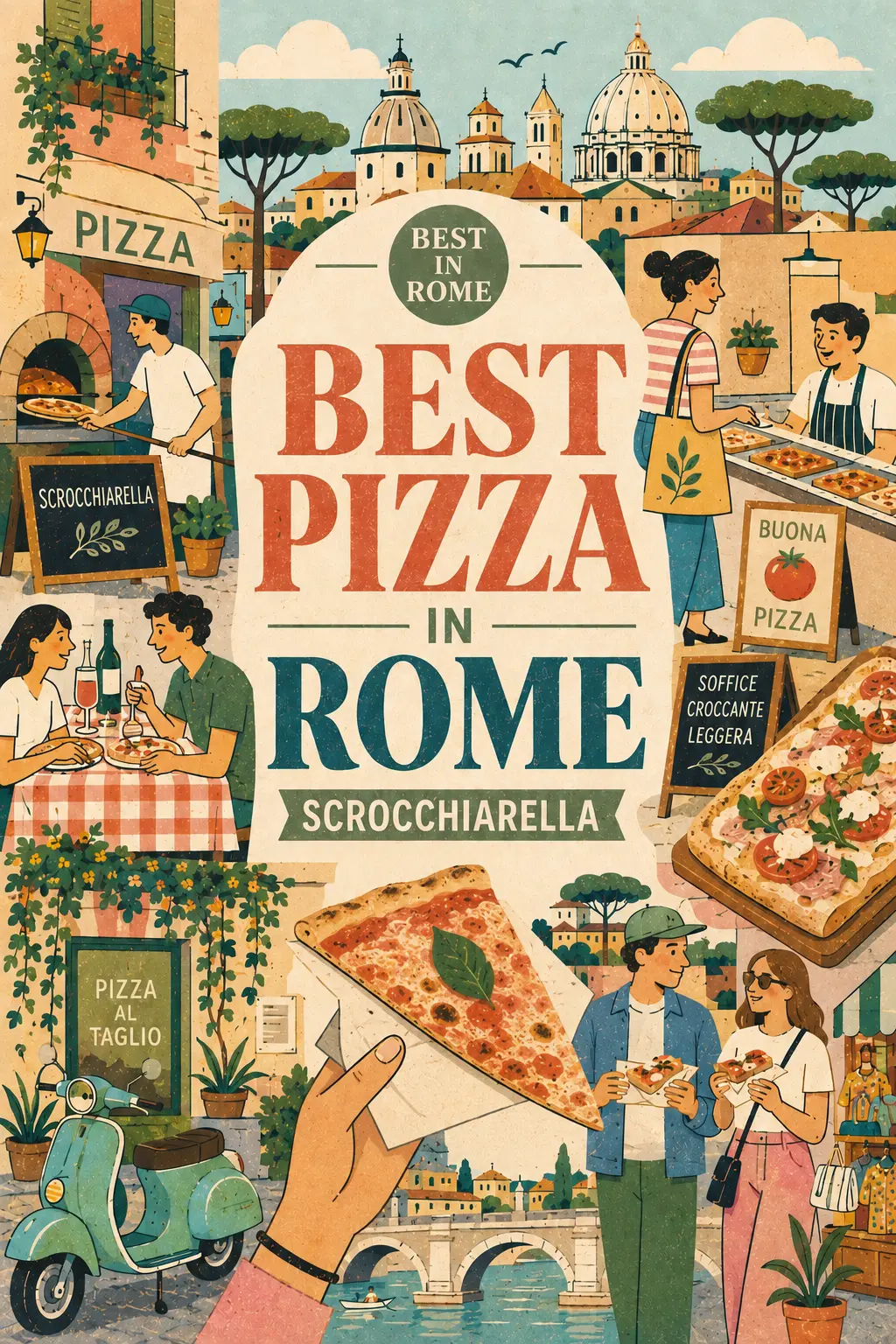

When most people think of Italian pizza, they think of Naples: the soft, puffy, leopard-spotted dough with a high airy cornicione. That is Neapolitan pizza, and it is wonderful. But it is not Roman pizza.
In Rome, pizza isn’t just pizza. If you want to eat like a local, you need to understand that the city’s pizza scene is split into three completely distinct universes:
- Pizza Tonda Romana (The Night Universe): This is the sit-down dinner pizza. It is paper-thin, rolled with a rolling pin (mattarello), has zero raised edge, and is baked until it reaches a genuine crackle. In Rome, we call it scrocchiarella.
- Pizza al Taglio (The Day Universe): Baked in long rectangular metal pans and sold by weight, this is Rome’s ultimate daytime street food. It is high, airy, crispy on the bottom, and tender on top.
- Pizza alla Pala (The Bakery Universe): A long, oval pizza served on a wooden paddle, common in traditional bakeries (forni). It is the perfect middle ground crispy on the outside, soft inside, and traditionally split open and filled with Mortadella.
This guide focuses exclusively on the first universe: the real pizza tonda romana, thin and crackling, the way it has always been made. Some of these places are decades old, some opened recently, but all of them respect the same tradition.
180grammi (Centocelle)
Jacopo Mercuro is one of the names that brought the Roman tonda back into the spotlight, and 180grammi in Centocelle is where he does it. The pizza here is everything Roman pizza should be: thin, manually stretched, long-fermented, and baked to a genuine crackle. The difference is in the quality of the ingredients and the precision of the execution.
The fried starters deserve as much attention as the pizza. The supplì in particular are among the best in the city. Centocelle is well outside the tourist centre, in Rome’s eastern neighbourhoods, which is exactly why the room is full of Romans rather than visitors.
- Address: Via Genazzano 32, Centocelle.
- Good to know: Book ahead, it fills up weeks in advance. Closed Tuesdays.
L’Elementare (Testaccio and Via Gallia)
L’Elementare makes the kind of Roman pizza I would send anyone to without hesitation. Thin, crisp, honest, with good ingredients and no pretension. The Testaccio location puts it right in the heart of Rome’s most food-focused neighbourhood, and the Via Gallia location near the Appio area is equally reliable.
What I like about L’Elementare is that it does not try to be more than it is. It is a neighbourhood pizzeria making excellent traditional Roman pizza at fair prices. That is exactly what you want.
- Address: Via degli Stradivari 27 (Testaccio) and Via Gallia 83 (San Giovanni).
- Good to know: Great craft beer selection on tap.
A Rota (Tor Pignattara)
A Rota, in the multicultural neighbourhood of Tor Pignattara east of the centre, is the project of Sami El Sabawy, a young pizzaiolo who trained at Pizzarium under Gabriele Bonci and then dedicated himself to the traditional Roman tonda. The result is scrocchiarella rolled by hand with a wooden pin, thin and light, with toppings that respect tradition while occasionally venturing into well-judged seasonal specials.
The fritti are excellent, particularly the supplì. The room is bright and simple. It is a long way from the tourist circuit, which is part of the appeal.
- Address: Via di Tor Pignattara 190.
- Good to know: Open evenings, closed Tuesdays. Special Sunday lunch opening.
Svario (Montesacro)
Svario, in the Montesacro area of Rome’s north, calls itself a pizza bar, and the idea is to pair real Roman pizza with serious cocktails. The pizza itself is properly traditional: rolled with a pin, 65% hydration, two flours, baked to genuine crispness. Two Spicchi from Gambero Rosso confirm the quality.
The signature here is the conchetta, a taco made from Roman pizza dough filled with Roman classics like polpette al sugo or baccalà. It sounds unusual but it is rooted entirely in tradition. The fried starters and the maritozzi salati are worth ordering.
- Address: Via Val di Senio 18, Montesacro.
- Good to know: Open Tuesday to Sunday evenings. Closed Mondays.
Crunch (Talenti / Monte Sacro Alto)
Crunch, in the Talenti neighbourhood of Rome’s north, opened in 2022 and quickly built a reputation for traditional Roman tonda done with technical precision. The dough is hand-stretched, thin and crisp, with a small percentage of farro and a long fermentation that makes it unusually digestible. It was awarded a Puntarella d’Oro.
The menu divides the pizzas into Easy, Medium and Hard, with the more ambitious options showing real skill in the toppings, including versions that reference Roman pasta dishes like carbonara and gricia. The fried starters are generous and creative.
- Address: Via Francesco d’Ovidio 27, Talenti.
- Good to know: Open evenings, closed Mondays.
Pizzeria Fleming (Roma Nord)
A more recent arrival in the Fleming area of northern Rome, Pizzeria Fleming is dedicated to the round Roman pizza: thin, crisp, long-fermented. The project comes from a serious group and the focus is on quality ingredients and traditional method. The fried starters cover the classics, supplì, fiori di zucca, baccalà, all well executed.
It is a neighbourhood pizzeria rather than a destination, with honest prices and a local crowd, which is exactly the point.
- Address: Via Flaminia 609, Fleming.
- Good to know: Open evenings from 19:30.
Pizzeria Remo (Testaccio)
Now the historic places. Remo, in Testaccio, has been making Roman pizza since 1976 and it is an institution. The pizza is the platonic ideal of scrocchiarella: bassa, stesa al mattarello, briefly leavened, cooked in a wood-fired oven for barely a minute. Thin, crisp, blistered, and cheap.
You cannot book. You take a number and you wait, and the queue is part of the experience. The service is fast and no-nonsense. For a starter, a capricciosa, and something to drink, you will still struggle to spend €20. There are few more authentic Roman experiences in the city. Testaccio is one of the most food-focused neighbourhoods in Rome and Remo is at the heart of it.
- Address: Piazza di Santa Maria Liberatrice 44, Testaccio.
- Good to know: Open evenings 19:00-01:00, closed Sundays. No reservations.
Da Ivo (Trastevere)
Ivo Stefanelli opened his pizzeria in Trastevere in 1962, when the neighbourhood was still entirely working-class, together with his wife Romana. Three generations later the family is still at the ovens. This is the historic Trastevere pizzeria, and the pizza is exactly what it should be: thin, crackling, generously topped, no gourmet experiments, just substance.
The room is small and lively. The fried starters and the calzone are excellent. In a neighbourhood that has become very touristy, Ivo remains genuinely Roman.
- Address: Via di San Francesco a Ripa 158, Trastevere.
- Good to know: Open evenings, closed Tuesdays.
La Montecarlo (Historic Centre)
La Montecarlo, a few steps from Corso Vittorio Emanuele II near Piazza Navona, has been open since 1986 and is the rare central pizzeria that still makes proper Roman scrocchiarella at reasonable prices. The location, deep in the tourist heart of the city, makes its authenticity all the more valuable.
Thin, crisp pizza, fast service, paper tablecloths, and a lively crowd that mixes Romans and visitors. There is outdoor seating in the warm months. For a central location, it is one of the most reliable choices in the city.
- Address: Vicolo Savelli 13, near Piazza Navona.
- Good to know: Open daily until late, closed Sundays.
Pizzeria Clementina (Fiumicino)
For a destination meal worth leaving the city for, Pizzeria Clementina on the canal at Fiumicino is extraordinary. Luca Pezzetta has built one of the best pizzerias in Italy here, awarded Tre Spicchi by Gambero Rosso 2026 with a score of 95 out of 100, and ranked 14th best pizzeria in Italy and 34th in the world by 50 Top Pizza.The pizza is Roman in spirit, thin and crisp, but elevated through technique and exceptional ingredients, with a particular gift for pairing pizza with fish given the seaside location.
It is about 30 minutes from the centre, near the airport, which makes it an ideal first or last meal in Rome (our transport guide covers how to get around Rome without overpaying). If you want to understand how far Roman pizza can be taken while remaining true to itself, this is the place.
- Address: Via della Torre Clementina 158, Fiumicino.
- Good to know: Booking essential. Closed Mondays. Open for lunch on weekends in autumn and winter only.
How to Tell Real Roman Pizza
A few things to look for, so you can recognise the real thing anywhere in the city.
The pizza should be thin all the way to the edge, with no raised, puffy cornicione. It should be crisp enough that a slice held by the crust stays more or less straight. The base should show some char from a hot oven. One technical detail that defines the difference: real Roman scrocchiarella is rolled with a wooden pin, the mattarello, not stretched by hand the way Neapolitan pizza is. This is the single most important distinction between the two traditions. The mattarello compresses the dough, pushes out the air, and creates the thin, rigid, crackling base that makes Roman pizza what it is. If the pizzaiolo is stretching the dough in the air with his fists, you are looking at a different kind of pizza.
And the experience should be fast: Roman pizzerias are not places for a three-hour dinner, they are places to eat well, quickly, and cheaply, usually with a few fried starters first.
One last local note: in a genuine Roman pizzeria, you start with fritti. Supplì, fiori di zucca, filetti di baccalà, crocchette. The supplì in particular is one of the essential dishes of Roman cuisine. Skipping the fried starters and going straight to pizza is the mark of someone who does not know how it is done here.
FAQ
What is scrocchiarella? Scrocchiarella is the Roman name for traditional thin-crust pizza. It comes from the verb scrocchiare, meaning to crackle. The dough is rolled with a wooden pin (mattarello) until it is almost translucent, then baked in a very hot oven until the base is crisp enough to snap. There is no raised edge, no puffy cornicione. When you pick up a slice it stays rigid and the first bite makes an audible crunch.
What is the difference between Roman and Neapolitan pizza? Neapolitan pizza has a soft, elastic dough stretched by hand, with a high puffy edge (cornicione) and a tender, slightly wet centre. Roman pizza is the opposite: rolled thin with a mattarello, no raised edge, baked until crisp all the way through. The texture is dry and crackling rather than soft and chewy. They are two completely different traditions and comparing them misses the point of both.
Where can I eat real Roman pizza near the centre? La Montecarlo on Vicolo Savelli 13, near Piazza Navona, is the most reliable option for genuine scrocchiarella in the historic centre. Da Ivo on Via di San Francesco a Ripa 158 in Trastevere is another strong choice within walking distance of the main tourist areas. For the full experience, take the metro to Testaccio and eat at Pizzeria Remo, which has been making the definitive Roman pizza since 1976.
All practical information verified in June 2026. Opening hours change and many pizzerias close one day per week, always check before you go. None of the places in this guide are sponsored or paid placements. These are personal recommendations from a Roman who was born and raised in this city and has no commercial relationship with any of the pizzerias listed. Just someone who has been eating pizza in Rome for a lifetime and knows the difference.
Leave a Reply