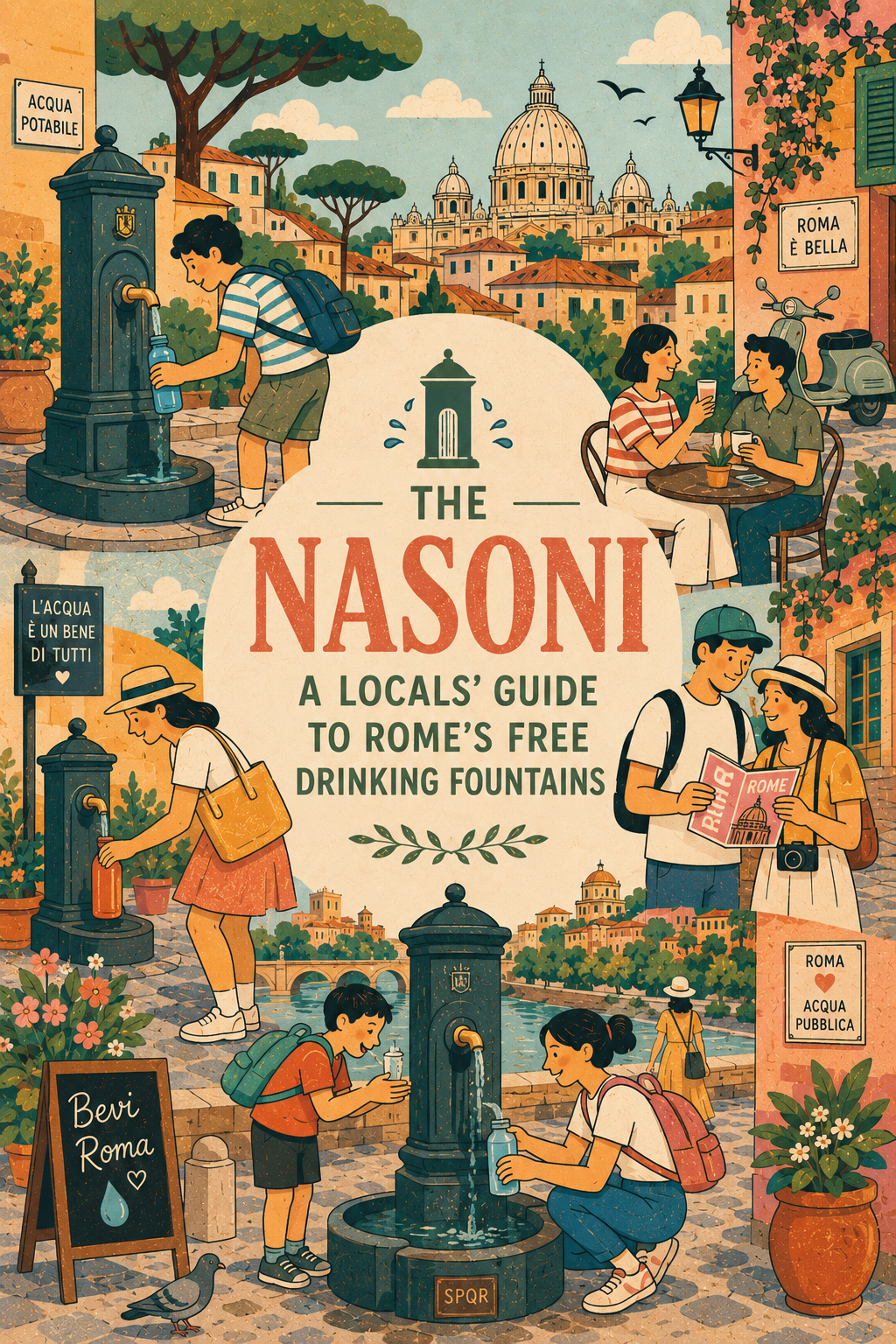

If you grew up in Rome like I did, the nasoni are just part of the background. Those small cast iron fountains on practically every corner, quietly running water all day, every day, for free. Tourists often walk right past them, not realizing they are looking at one of the most useful things in the entire city.
What exactly is a nasone
The name means “big nose” in Italian, and it comes from the curved spout that looks a bit like a nose in profile. The first ones appeared in 1874, commissioned by Rome’s mayor at the time, Luigi Pianciani, to bring free public water to the city. The earliest versions actually had three spouts shaped like dragon heads, later simplified into the single curved nose we see today. There are over 3,000 of them across Rome now, including more than 200 in the historic center alone, each one cast in iron, about 120 centimeters tall, and weighing around 100 kilograms. The water keeps flowing constantly rather than on demand, which is intentional: it helps maintain pressure in the city’s water network and keeps the water fresh.
Is the water actually safe to drink
Yes, completely. The water comes from the same network that supplies tap water to homes across the city, and it is tested regularly by Acea, the company that manages it. Romans drink from nasoni all the time, including me, my family, and pretty much everyone I grew up with. If a nasone is ever out of service, it gets sealed off, so if water is flowing, it is safe.
The local trick: how to drink without bending over
Here is something most visitors never figure out on their own. The spout points downward and the water runs out continuously, which makes it awkward to drink from directly. The trick is to place your finger or palm gently over the end of the spout. This blocks the main flow and forces a thin stream of water up and out through a small hole on the top of the pipe, creating a perfect little drinking fountain. Cover the spout, not your hand, and you will get it on the first try.
Finding the nearest nasone
Acea has an app called Acquea that shows the location of every nasone in the city, along with other water points like the larger drinking fountains near major attractions, some of which even offer sparkling water. It works well even with patchy signal, which is useful if you are wandering around smaller side streets where reception can be unreliable.
Where you will find the most useful ones
Nasoni are everywhere, but a few clusters are worth knowing about. There is almost always one near major squares and along the main routes between big attractions, so you rarely have to go far out of your way. Around the Colosseum and Roman Forum area in particular, the free water points become genuinely important during the hotter months, since shade is limited and the walk between entrances is longer than it looks on a map.
A practical tip from a local
Bring a reusable bottle. It sounds obvious, but I see visitors buying bottled water from street vendors at inflated prices when there is a nasone just around the corner. Filling up before you set out for the day, and topping off whenever you pass one, is exactly what locals do, especially during the summer when temperatures climb and the city asks residents to stay hydrated and avoid the hottest hours outdoors.
The nasoni are a small thing, but they say something about Rome: practical, a little stubborn, and built to outlast whatever the weather throws at it.

Leave a Reply